
ApexBrasil has identified 434 business opportunities in Mexico, including some linked to the country’s hosting of the 2026 FIFA World Cup.
One of the objectives of this Brazilian government agency is to promote the country’s exports.
These potential business opportunities were identified through the agency’s Opportunity Map.
Business Opportunities in Mexico
In 2026, trade between the two nations totaled $13.948 billion, according to data from Brazil’s Ministry of Development, Industry, and Foreign Trade.
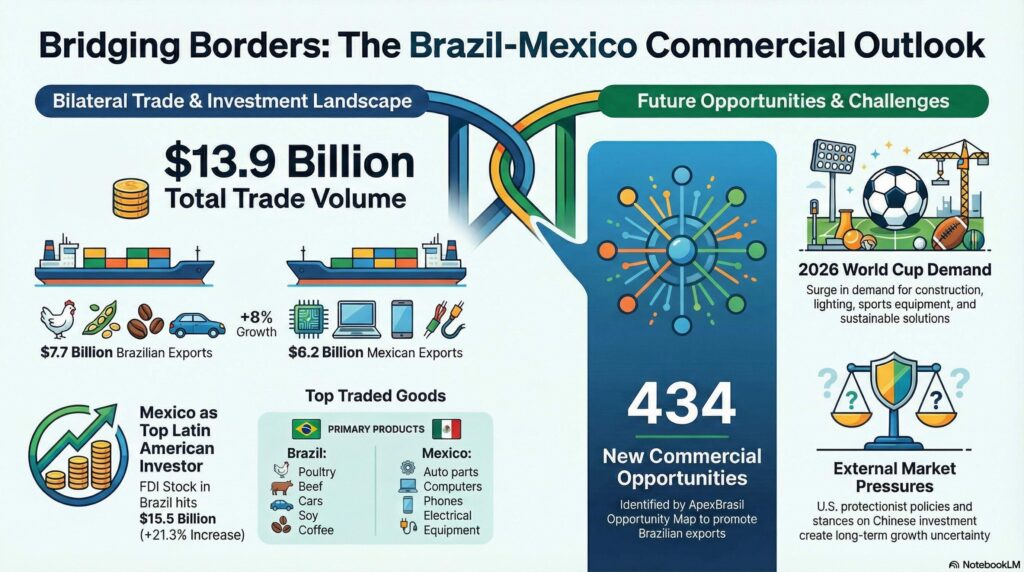
As part of these trade flows, Brazilian exports recorded a year-over-year decrease of 1%, to $7.730 billion. Conversely, Mexican sales totaled $6.218 billion, an 8% increase over 2024.
Brazil exports mainly chicken, cars, beef, freight vehicles, soybeans, and coffee to the Mexican market. In turn, Mexico exports mainly auto parts, cars, and computers to the Brazilian market. It also exports instruments and devices for control or regulation, freight vehicles, telephones, and electrical lighting equipment.
As a result of projects related to the 2026 World Cup, Mexico has a growing demand for construction materials, lighting, sports equipment, and sustainable solutions. Furthermore, Brazil is competitive in these sectors.
At the same time, ApexBrasil supports 24 sector-specific projects focused on Mexico, including the food, beverage, and agribusiness sectors, housing and construction, the creative economy, and machinery and equipment. It also covers fashion, multisectoral initiatives, technology, and healthcare.
ApexBrasil’s Opportunity Map identifies products with export potential to Mexico. These include motor vehicles, power generation machinery, and chemicals, among others.
Challenges
According to the Economist Intelligence Unit, a more aggressive stance by the United States regarding Chinese investment in Mexico will put pressure on Foreign Direct Investment and trade flows. Consequently, this will restrict long-term growth prospects.
In terms of trade, U.S. protectionist policies affect Brazilian companies operating in Mexico.
Despite Mexico’s strategic position in nearshoring to the United States, U.S. protectionist tariff policies raise costs and create uncertainty, reducing the country’s appeal as a production base.
FDI
Mexico also stands out as an investor in Brazil. In 2023, the country reached an FDI stock of $15.5 billion, becoming the largest Latin American investor in Brazil. This figure represents a year-over-year growth of 21.3 percent.