
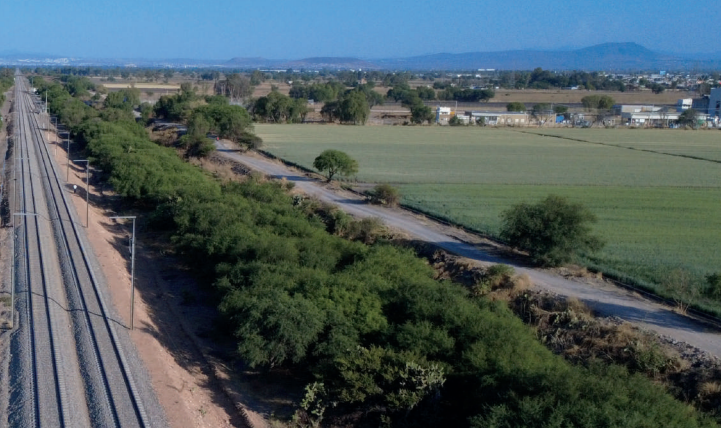
The AIFA-Pachuca train connections for passenger transport in Mexico will increase logistical competitiveness between Mexico City, the state of Hidalgo, and the State of Mexico.
The passenger train project connecting AIFA with Pachuca is 57 kilometers long, with double electrified tracks and catenary traction, designed to reach speeds of up to 130 km/h.
AIFA-Pachuca train connections
The new railway line will have eight stations. They will be located in Xaltocán, Xolox, Huitzila, Tizayuca/Temascalapa, Empalme del Rey, Parque Industrial Platah, Jaguey de Téllez, and Pachuca. In addition, it aligns with the Suburban Train and Lechería-AIFA branch line standards. This will facilitate integration between Mexico City, the State of Mexico, and Hidalgo, with better regional connectivity and unified system operation.
Comprehensive project
President Claudia Sheinbaum elevated the passenger railway to a strategic national infrastructure project. In 2024, she confirmed three new routes. In addition, she plans to build 3,000 km of track in four phases, marking a return of the train as a hub for mobility and economic development.
The projects are:
Mexico City–AIFA–Pachuca passenger train:
A railway project that will connect the capital with Felipe Ángeles International Airport and Pachuca. It aims to reduce travel times, offer fast mobility for passengers and workers, and strengthen metropolitan interconnectivity with an accessible and modern system.
Mexico City–San Luis Potosí–Monterrey–Nuevo Laredo passenger train:
A strategic railway line to connect the center with the industrial north. It will facilitate the movement of people, tourism, and business. In addition, it will boost nearshoring by linking Monterrey and the U.S. border, promoting regional economic development.
Mexico–Querétaro–Guadalajara–Tepic–Mazatlán–Nogales passenger train:
A railway route that will link the center of the country with the Pacific and the northwest border. It will enable long journeys with greater interstate connectivity, promote tourism and port trade, and integrate into the economic corridor to the United States.