

The expansion of artificial intelligence is increasing demand for copper in the United States and Asia, primarily due to the construction of data centers, the expansion of power grids, and the implementation of advanced cooling systems.
Data centers use copper in cables, busbars, transformers, circuits, connections, and cooling equipment. Some estimates put consumption at nearly 27 metric tons of copper per megawatt of installed capacity.
AI Infrastructure
Copper usage can be several times higher in data centers designed for artificial intelligence than in traditional facilities. However, the exact ratio depends on capacity, server density, the cooling system, and whether the calculation includes only the building or also the electrical infrastructure that powers it.
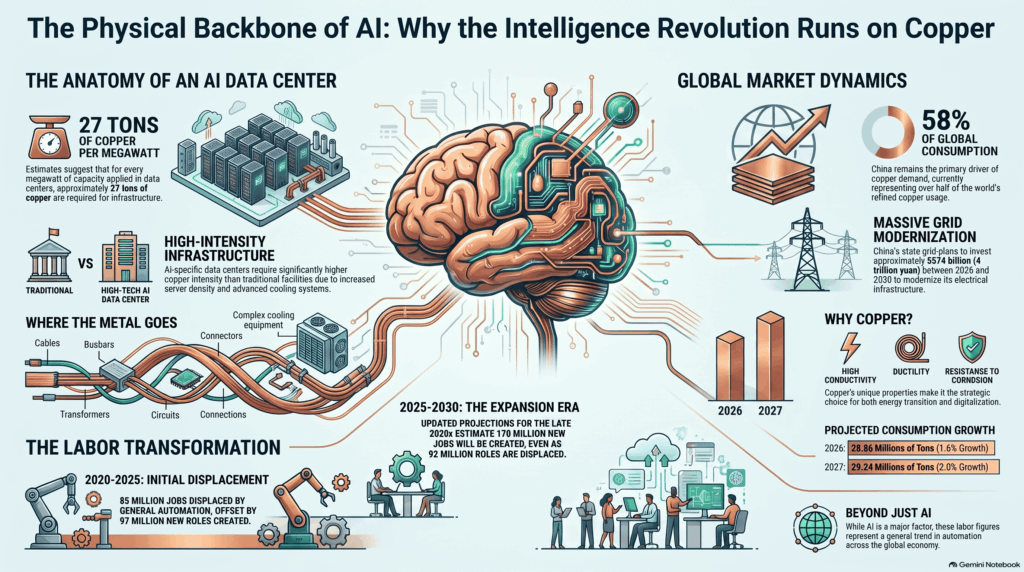
The growth of AI is also linked to a transformation of the labor market. In 2020, the World Economic Forum estimated that automation would displace 85 million jobs and create 97 million new roles by 2025. However, that figure was a general projection regarding automation and not an estimate specific to jobs in artificial intelligence. The 2025 report forecasts 170 million new jobs and 92 million displaced jobs between 2025 and 2030.
Demand for Copper
As for refined copper, the International Copper Study Group projects global consumption of 28.66 million metric tons in 2026 and 29.24 million in 2027, representing increases of 1.6% and 2%, respectively. Asia will continue to be the main driver of demand, with China accounting for approximately 58% of global refined copper consumption.
China is also driving demand through the modernization of its power grid. Its state-owned grid company has announced an investment plan of about 4 trillion yuan—equivalent to roughly $574 billion—for the 2026–2030 period.
Copper is strategic for the energy transition and digitalization due to its high electrical and thermal conductivity, ductility, malleability, and corrosion resistance. In addition to data centers, it is used in power grids, telecommunications, construction, transportation, machinery, plumbing, roofing, and the manufacture of alloys such as brass.