
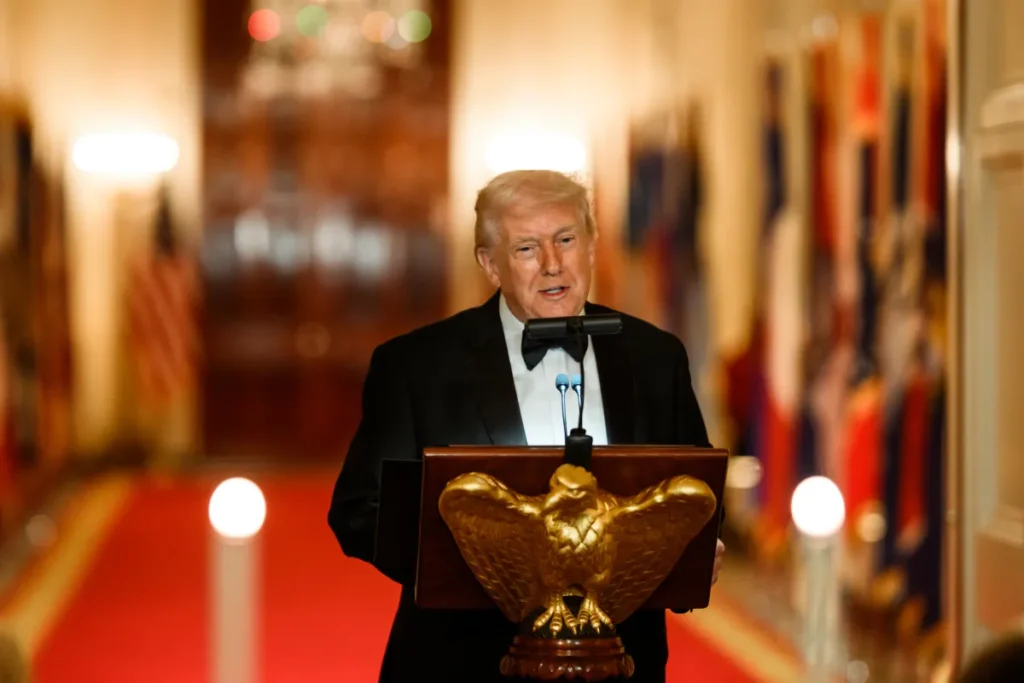
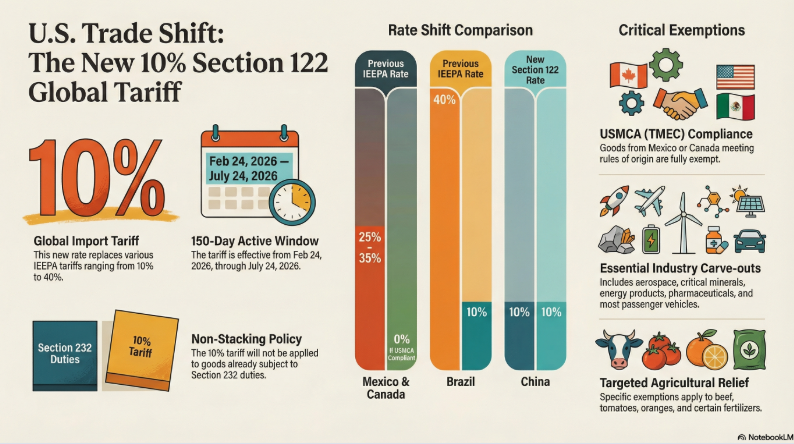
The United States activated a 10% global tariff under Section 122 of the Trade Act of 1974, effective February 24 at 12:01 a.m. and lasting 150 days, until July 24, 2026.
The measure replaces the tariffs imposed under the IEEPA, following the Supreme Court ruling that limited that presidential power.
Section 122, administered by U.S. Customs and Border Protection, authorizes levies of up to 15% for balance of payments imbalances. Although U.S. President Donald Trump announced an increase to 15%, this has not been officially implemented.
10% global tariff
For Mexico and Canada, goods that comply with the rule of origin of the United States-Mexico-Canada Agreement are exempt from the additional tariff. This reduces the direct impact on regional foreign trade and preserves nearshoring incentives in North America.
However, exports that do not qualify for preferential origin will face an additional 10% tariff, which is cumulative with Most-Favored-Nation, Section 301, or other non-exempt tariffs. This requires strengthening traceability, certification of origin, and regulatory compliance in supply chains.
Exempt goods and strategic sectors
Exempt goods include textiles under CAFTA-DR, certain vehicles, aerospace components, critical minerals, energy, fertilizers not produced in the United States, specific agricultural products, and pharmaceuticals. Certain electronic components are also excluded.
In addition, a non-cumulation scheme is established with Section 232 tariffs. When a good is subject to 232—such as steel or aluminum—the 10% will only apply to the value not previously taxed. This mitigates distortions in advanced manufacturing and metallurgical sectors.
Replacement of IEEPA tariffs and geopolitical environment
Section 122 tariffs replace previous levies under the International Emergency Economic Powers Act (IEEPA), which included rates of 25% on Mexico, 35% on Canada, and 10% on China for reasons related to fentanyl and migration, among other reciprocal and energy schemes.
The change reconfigures the architecture of U.S. trade policy. Although it reduces legal uncertainty, it maintains widespread tariff pressure. For Mexican exporters, the key will be to preserve USMCA eligibility and avoid cumulative exposure.
Strategic implications for foreign trade and nearshoring
What does this mean for Mexico? In the short term, relative stability for goods of regional origin. In the medium term, greater scrutiny of rules of origin and regional content. Also, sectors linked to critical minerals and energy remain a strategic priority.
From a business perspective, the measure requires internal compliance audits, review of tariff classifications, and assessment of the impact on logistics costs. The interaction between Sections 122, 232, and 301 could alter margins and foreign direct investment decisions.