

The U.S. company Nucor stated that Section 232 is more effective for steel products than anti-dumping and countervailing duties.
The Section 232 steel tariffs were fully reinstated in 2025—with no exceptions or exclusions—and expanded to cover approximately 600 manufactured steel products.
Effectiveness of Section 232
Nucor Corporation is North America’s largest steel manufacturer and recycler. It produces its steel in electric arc furnaces using primarily recycled scrap. Its business is divided into three segments: steel mills, steel products, and raw materials.
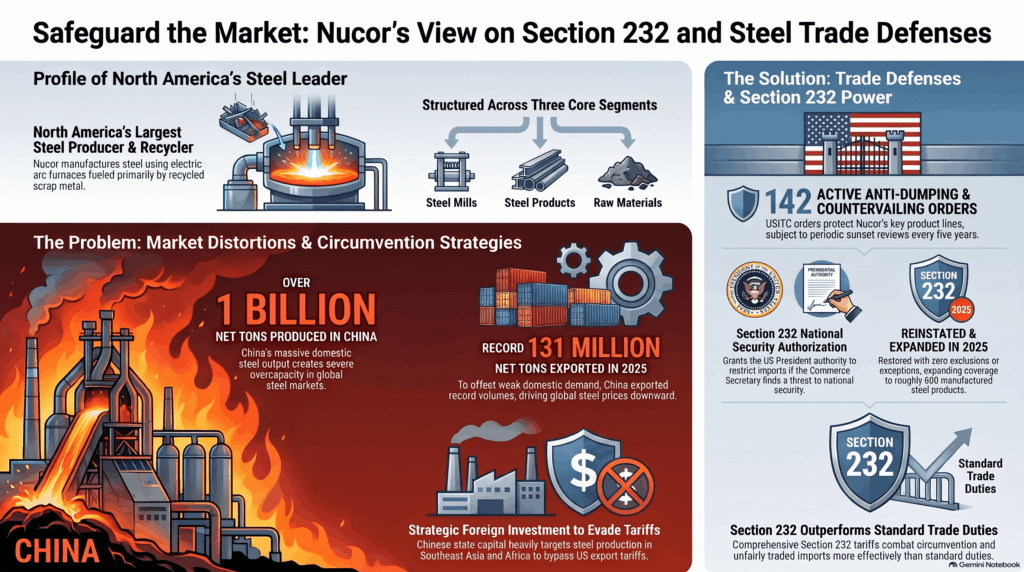
Section 232 authorizes the president to impose trade restrictions if the Secretary of Commerce determines that imports of a good “threaten to harm U.S. national security.”
These comprehensive tariffs have proven more effective in combating circumvention practices and preventing imports subject to unfair trade from entering the U.S. market.
Unfair Competition
For Nucor, the circumvention of trade duties poses a constant threat. Currently, China produces more than 1,000 million metric tons of net steel within its own territory. In addition, the Asian giant invests heavily in steel production in other countries.
With this strategy, it seeks to avoid paying tariffs on its exports to the U.S. market. As a result, most of these state investments are concentrated primarily in Southeast Asia and Africa.
To offset weak domestic demand, China exported a record 131 million metric tons net in 2025, which put downward pressure on steel prices in markets around the world.
The trade defense mechanisms implemented by the U.S. International Trade Commission (USITC)—such as antidumping and countervailing duties—play a fundamental role in the market. These measures ensure that the U.S. steel industry competes on a level playing field in the face of external distortions. In this way, the domestic sector is able to effectively protect itself against imports subject to unfair trade practices.
Currently, there are 142 anti-dumping or countervailing duty orders in effect on the main lines of steel products manufactured by Nucor. In addition, periodic reviews (known as “sunset reviews”) are conducted every five years regarding specific exporters and products.