

The European Union is interested in playing a greater role in Mexico’s dependence on foreign inputs incorporated into Mexican exports.
Furthermore, the European Union has contributed significantly to the growth of Foreign Direct Investment (FDI) in Mexico, accounting for approximately 30% of the country’s total FDI stock.
Dependence on Foreign Inputs
Furthermore, an analysis by the European Parliament highlights the fact that, at the international level, foreign value added in Mexican exports reached 35.9 percent in 2018.
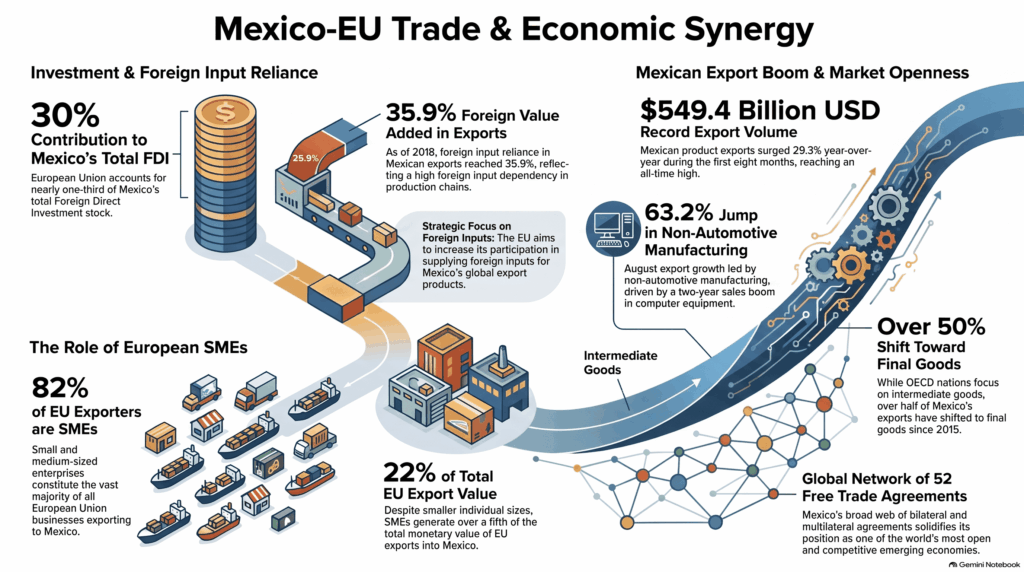
This indicates that Mexico has a relatively high dependence on foreign inputs in its production chains.
In contrast, the pattern of exports—which is more oriented toward intermediate goods than final goods—predominates in the countries of the Organization for Economic Cooperation and Development (OECD).
However, since 2015, there has been a slight shift in the composition of goods exported by Mexico, as final goods now account for just over 50% of the total.
Finally, it is worth noting that small and medium-sized enterprises (SMEs) constitute a very significant portion of the total number of European Union exporters to Mexico. They account for 22% of the total value of European Union exports and 82% of all European Union companies that export to Mexico.
Mexican Exports
Exports of Mexican goods posted a year-over-year increase of 29.3% in the first eight months of 2026. This figure reached a record high of 549,397.6 million dollars.
In August alone, Mexican exports were driven primarily by non-automotive manufacturing exports. This sector surged by 63.2%. Within this industrial sector, sales of computer equipment have boomed over the past two years.
Open Trade
The same analysis indicates that Mexico is establishing itself as a dynamic emerging economy. It shares fundamental values with the European Union, such as open, fair trade based on international standards.
Over the past two decades, Mexico’s GDP growth has followed a trajectory similar to that of the European bloc. Currently, the country has an extensive network of free trade agreements with 52 nations. Thanks to this integration, it ranks as one of the most open and competitive markets in the world.