

The impact of the Middle East conflict on the Chilean economy has been positive, though tempered by other circumstances, according to the Chilean government.
More broadly, the conflict has affected the Chilean economy through multiple channels, although the country’s position as the world’s largest copper producer has served as a partial counterbalance.
The main transmission channel has been commodity prices, which have shown significant volatility. Copper prices have reached historic highs of over $6.00 per pound, while oil prices have also risen sharply.
Impact of the Middle East Conflict
Nevertheless, on a net basis, Chile’s terms of trade have been bolstered by the relatively stronger performance of copper. This development continues a trend that the Central Bank had already observed prior to the conflict.
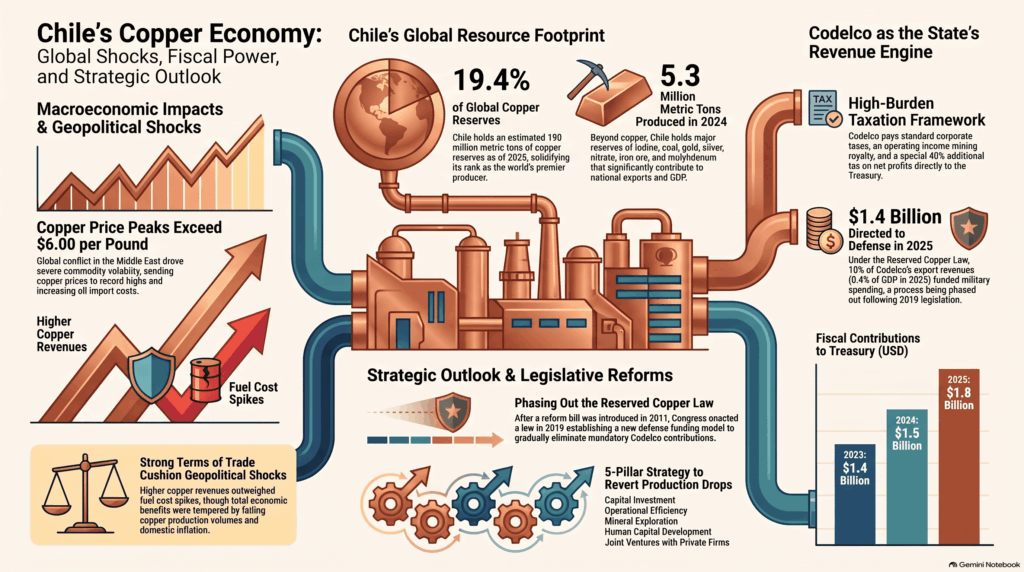
However, the benefits have been offset by a decline in copper production volumes. Added to this are growing inflationary pressures stemming from fuel costs and a weak labor market.
Codelco as the Government’s Cash Cow
The Chilean state-owned copper company Codelco paid $1.8 billion in taxes and other contributions to the Treasury in 2025, following $1.5 billion in 2024 and $1.4 billion in 2023.
Codelco pays an additional 40% tax on its net profits, in addition to the standard corporate tax and a mining levy on its operating income.
At the same time, the Copper Reserve Law requires that 10% of Codelco’s revenue from copper and byproduct exports be allocated to defense spending. In 2025, that transfer amounted to $1.4 billion, equivalent to 0.4% of GDP.
In 2011, a bill was introduced in Congress aimed at creating a new financing model for military spending, eliminating the contributions established in the Reserved Copper Law. Then, in 2019, Congress enacted a law establishing a mechanism to finance national defense, gradually phasing out Codelco’s mandatory contributions to national defense spending.
Codelco seeks to increase production and revenue through capital investment, operational improvements, exploration, human capital, and partnerships with private companies. The question is whether these partnerships will be enough to reverse the decline in production and finance large-scale projects.
Mining in Chile
Chile has large reserves of metallic and nonmetallic mineral resources. The country is the world’s largest copper producer. In 2025, it had estimated copper reserves of 190 million metric tons. This represented 19.4% of global reserves.
Chile produced 5.3 million metric tons of copper in 2024. Chile also has large deposits of iodine, coal, gold, silver, nitrate, iron ore, and molybdenum.
Consequently, the mining sector contributes significantly to the country’s exports and GDP. While non-manufactured mining exports are counted within the mining sector, the mining production process is included in the manufacturing sector.