

FDI trends in the United States over the past decade marked a turning point as the country shifted to a net recipient status. Although the flow moderated in 2025, acquisitions in manufacturing rebounded, as did the technology boom driven by artificial intelligence.
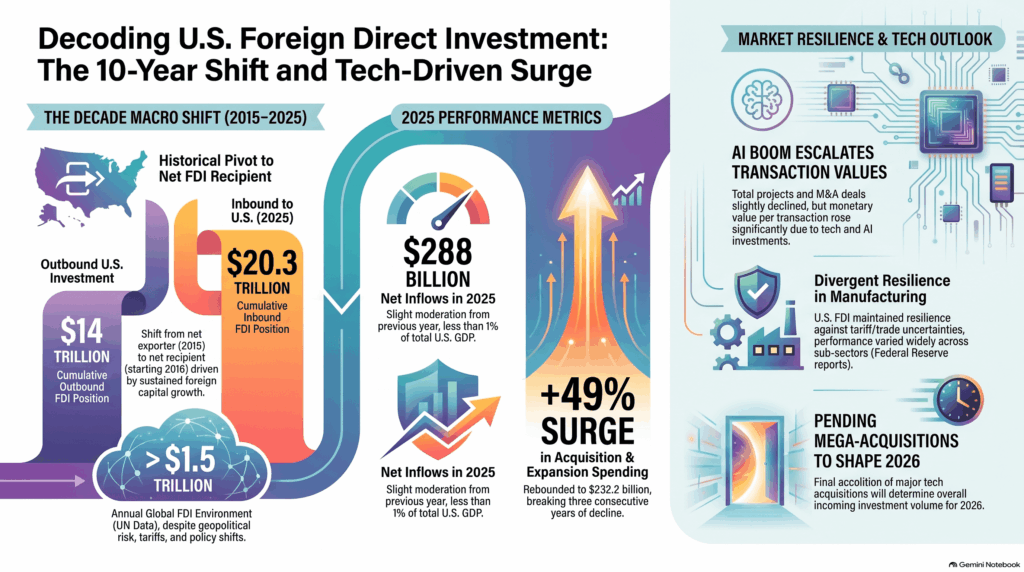
Driven by cumulative changes in transactions, the net FDI position in the United States shifted dramatically. As a result, the country went from being a net outflow country in 2015 to a net inflow country starting in 2016.
This shift was a response to the steady growth of foreign capital on U.S. soil. These flows exceeded outward investment. Consequently, inflows reached $20.3 trillion, compared with outflows of $14 trillion in 2025.
FDI Trends in the United States
Intense movements of capital and talent are transforming corporate and wealth management strategies. According to the UN, global FDI flows exceeded $1.5 trillion annually over the past decade.
This rapid cross-border expansion has increased financial risks and operational complexity for businesses. Furthermore, geopolitical volatility, new tariffs, and changes in immigration policies have heightened uncertainty for investors.
Declining FDI Flows
The flow of international capital into the United States has recently slowed. In 2025, net inflows totaled $288,000 million, slightly below the previous year’s level and representing less than 1% of GDP.
Despite this slowdown, first-year spending on acquiring or expanding businesses grew 49% to $232,200 million. This broke a three-year streak of declines, driven by the manufacturing sector and corporate acquisitions.
Resilience in the United States
According to the Fed, FDI in the United States showed resilience throughout 2025 in the face of trade and tariff uncertainty. However, this overall result masks divergent performance across different manufacturing sectors.
The Fed also noted a slight decline in the number of greenfield projects and cross-border acquisitions. Despite this lower volume of transactions, the monetary value of announced deals saw a significant increase.
This uptick was driven by the boom in artificial intelligence and the appeal of U.S. technology companies. Thus, the completion of these major acquisitions will determine the final volume of incoming investment for 2026.