
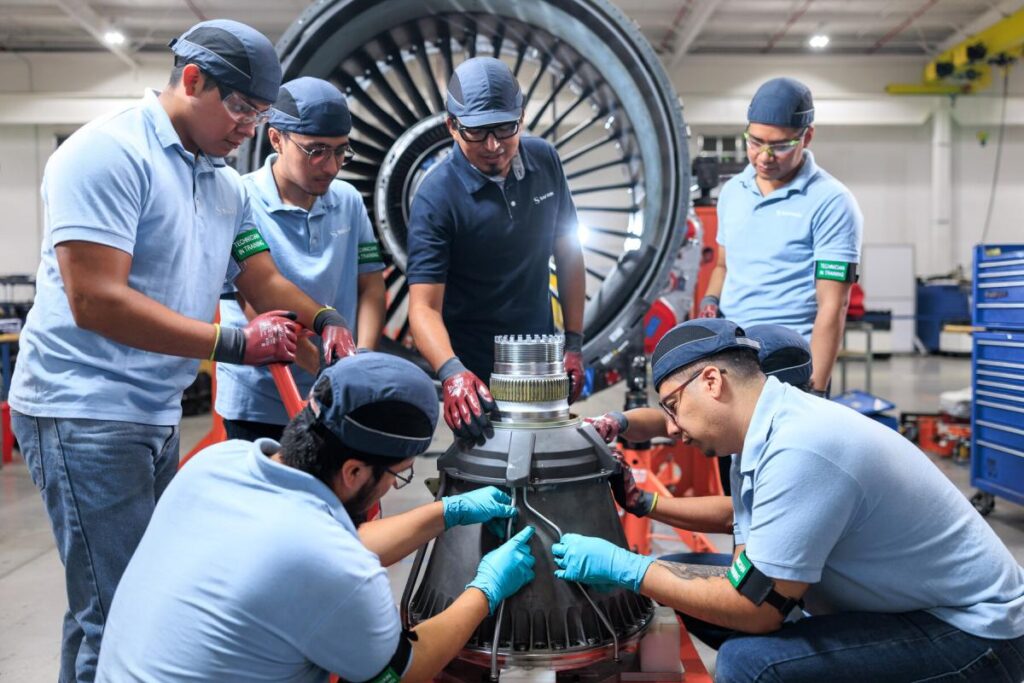
Safran’s MRO services in Mexico have expanded to four facilities covering an area of 50,000 m².
Safran is an international high-tech group specializing in aerospace, defense, and space. In 2025, it reported adjusted revenue of 31,329 million euros, a year-over-year increase of 14.7%. Its net income attributable to the group totaled 3,174 million euros, up 3.5% from 2024, and it had more than 110,000 employees.
Safran’s MRO Services in Mexico
Safran Aircraft Engines Services Americas (SAESA) is setting a new benchmark for MRO (Maintenance, Repair, and Overhaul) services dedicated to next-generation engines.
Safran’s MRO center combines an industrial footprint of 50,000 m² spread across four facilities. These include two maintenance shops, one repair shop, and a state-of-the-art test cell. Everything is designed to meet ambitious environmental standards.
The newest maintenance shop and the test cell were inaugurated on June 30, 2026. Furthermore, with a workforce of 1,450 highly qualified employees, SAESA offers the full MRO cycle for engines. This cycle ranges from receipt, inspection, repair, and component replacement to reassembly, testing, and delivery. All of this is complemented by ongoing customer support.
By 2030, the plant plans to reach a capacity of 350 engine inspections per year. To achieve this, it plans to hire 230 people in 2026.
In addition, the site is establishing itself as a hub for talent development thanks to its 1,800 m² Training and Certification Center. This center has the capacity to train 300 inspectors and technicians annually from Mexico, India, and Morocco, in close collaboration with local institutions and Safran’s global MRO network.
Maintenance Centers
Safran strives to offer competitive and tailored business solutions. In the civil engine sector, the company is expanding its global MRO capacity to meet demand. This involves the construction of new facilities, such as the maintenance centers in Hyderabad (India) and Casablanca (Morocco). It also includes the expansion or reinforcement of existing industrial capabilities, particularly in France, Mexico, and Belgium.
Mexico ranks among the top 15 players in the global aerospace industry thanks to its high-precision manufacturing, export capacity, and integration into global supply chains.