

The U.S. Chamber of Commerce (USCC) stated that U.S. ethanol producers are at a disadvantage compared to Brazil and called on the U.S. Trade Representative (USTR) to take action on the matter.
In 2025, the United States imported $145 million worth of ethanol from Brazil. Meanwhile, its exports of that product to the Brazilian market totaled $97 million.
U.S. ethanol producers
Prior to February 2023, U.S. ethanol entered Brazil duty-free under a tariff quota program. Subsequently, Brazil imposed a 16% tariff. This rate rose to 18% in 2024, compared to the 2.5% tariff the United States applied to Brazilian ethanol prior to August 2025.
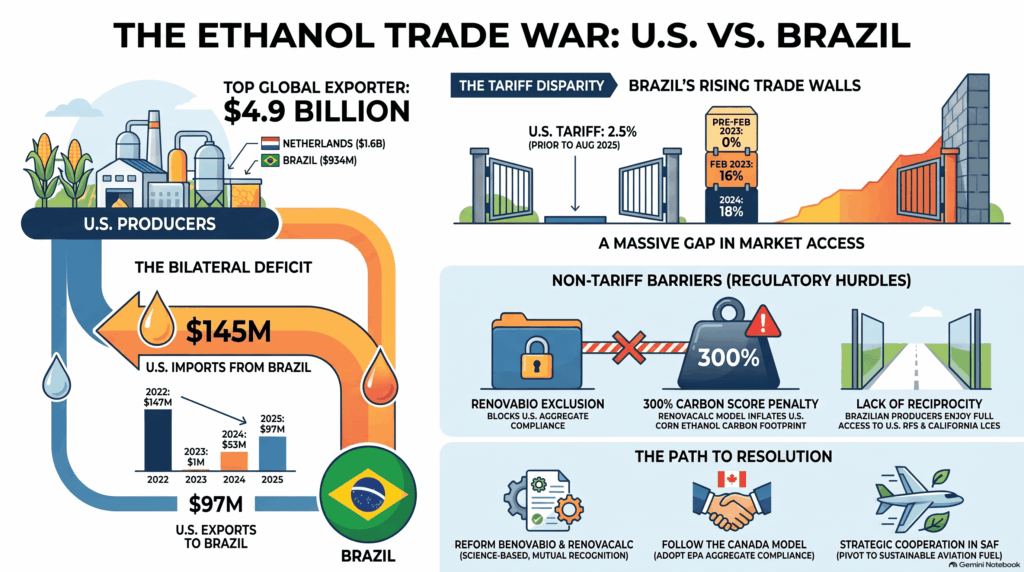
According to the USCC, non-tariff barriers exacerbate this imbalance. While Brazilian producers benefit from access to the U.S. Renewable Fuel Standard (RFS) and California’s Low-Carbon Fuel Standard, U.S. producers do not receive equivalent treatment in Brazil.
The Brazilian programs RenovaBio and RenovaCalc pose additional obstacles. RenovaBio’s eligibility criteria do not recognize the EPA’s “aggregate compliance” approach, which in practice prevents U.S. producers from qualifying for them.
Meanwhile, RenovaCalc’s carbon calculation model unfairly inflates the carbon score of U.S. corn ethanol, imposing a 300% penalty that limits access to CBio carbon credits and undermines U.S. competitiveness.
Global Trade
The United States ranked as the world’s largest ethanol exporter in 2025, with $4,909 million. The Netherlands took second place, with $1,643 million. And Brazil ranked third, exporting $934 million.
Ethanol is used worldwide as a vehicle biofuel to reduce emissions. It serves as a solvent in the chemical, cosmetic, and pharmaceutical industries. It functions as an antiseptic and disinfectant for medical use. And it is also the base ingredient in alcoholic beverages.
U.S. ethanol imports from Brazil fell from $270 million in 2022 to $233 million in 2023. They then fell again from $211 million in 2024 to $145 million in 2025.
Conversely, U.S. exports to the Brazilian market plummeted from $147 million to $1 million. They later rose from $53 million to $97 million.
In this context, the USCC argued that the USTR should urge Brazil to reform RenovaBio and RenovaCalc by promoting mutual recognition of environmental standards—including the EPA’s “aggregate compliance” approach, already accepted by Canada. Additionally, they recommended adopting transparent, science-based carbon calculation systems that ensure fair treatment for U.S. ethanol producers.
The combined effect of tariff gaps and barriers to accessing these programs not only undermines the competitiveness of U.S. producers but also destabilizes prices and hinders energy cooperation between the world’s two leading ethanol powers.
Given this scenario, the USCC urged both governments to collaborate on the development of sustainable aviation fuels, an area of growing strategic importance where U.S. companies have key advantages to offer.