

Exports of advanced-technology aerospace products from Mexico to the United States grew at a year-over-year rate of 23.9% in the first half of 2026. This growth enabled exports to reach $2,046 million, according to data from the Department of Commerce.
In general, Mexico’s main aerospace exports include engine components, turbines, fuselages, landing gear, and electrical harnesses. These shipments also include aviation systems, control surfaces, and composite materials. In addition to these products, the sector includes maintenance, repair (MRO), and advanced engineering services.
Aerospace Product Exports
According to the Mexican Aerospace Industry Federation (FEMIA), Mexico ranks among the top 10 manufacturers of aerospace products.
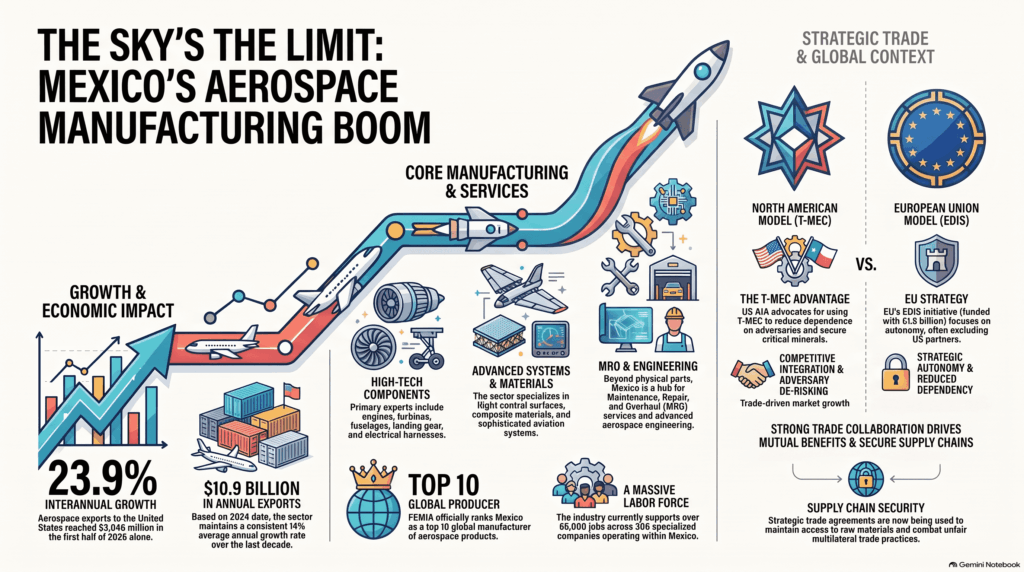
In 2024, Mexican exports from the sector totaled $10.9 billion. These exports grew at an average annual rate of 14% over the past decade. There are 386 companies operating in the aerospace sector in the country, generating more than 65,000 jobs.
The Aerospace Industry under the USMCA
In late 2025, the U.S. Aerospace Industries Association (AIA) called on the U.S. Trade Representative (USTR) to take greater advantage of the United States-Mexico-Canada Agreement (USMCA).
From their perspective, trade agreements can also be strategically leveraged to reduce dependence on supply chains linked to adversaries and increase the competitiveness of U.S. exporters.
For example, the AIA argued that the USMCA has supported the U.S. aerospace and defense sector. It has done so by helping it compete against foreign aerospace industries, both established and emerging.
In the AIA’s view, the USMCA can be leveraged even further to strengthen supply chains and maintain access to critical minerals and raw materials. It can also reduce dependence on adversaries and take multilateral action against their unfair practices.
European Defense
In 2024, the European Union (EU) published the European Defense Industrial Strategy (EDIS), a pioneering initiative aimed at increasing defense readiness and strategic autonomy at the EU level. Meanwhile, it also aims at reducing defense dependencies.
The EDIS included a regulatory and budgetary proposal—allocated 1,500 million euros for the 2025–2027 period—to establish a clear framework and investment structure for the EU’s defense industry. However, its strategic approach excluded key partners such as the United States.
At the same time, the European Council has promoted measures to limit the use of the U.S. Foreign Military Sales (FMS) program among member states.
AIA members welcomed the fact that U.S. President Donald Trump secured commitments from the EU to purchase more U.S.-manufactured defense equipment.