

U.S. pork producers highlighted both the opportunities and constraints for exporting to African countries.
In a letter addressed to the U.S. Trade Representative (USTR), the National Pork Producers Council (NPPC) stated that it supports the objectives of the African Growth and Opportunity Act (AGOA).
These objectives include expanding U.S. trade and investment with sub-Saharan Africa, stimulating economic growth, promoting economic integration, and facilitating the region’s integration into the global economy.
U.S. Pork Producers
The NPPC also stated that it supports AGOA’s trade preferences, which allow eligible countries to access the U.S. market duty-free, provided that those countries offer reasonable and equitable market access for U.S. exports.
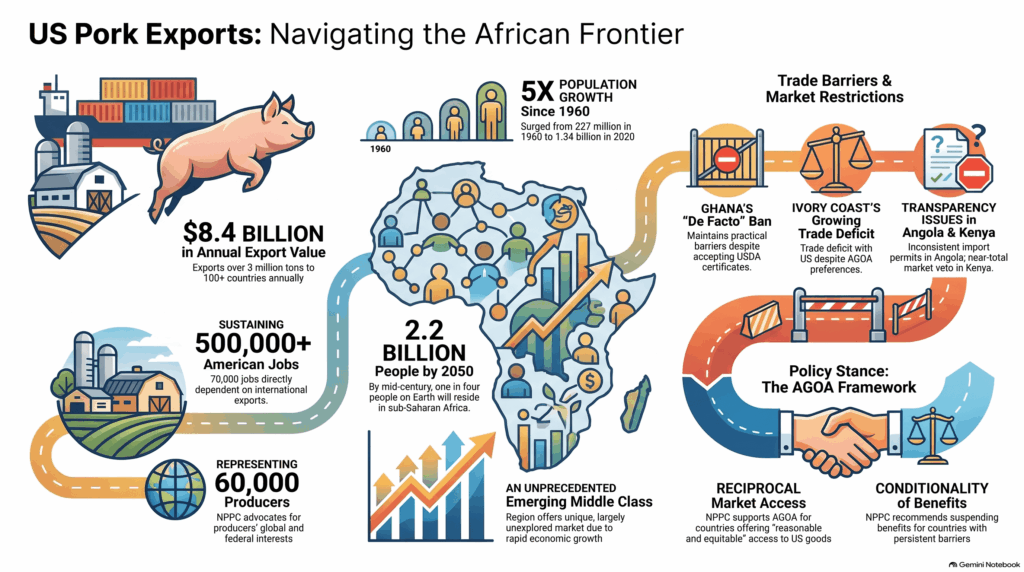
The NPPC is a national association representing the global and federal public policy interests of more than 60,000 U.S. pork producers.
Meanwhile, the U.S. pork industry is a key value-added sector within the agricultural economy. This sector contributes significantly to the country’s overall economy. In terms of employment, pork production in the United States supports more than 500,000 U.S. jobs. Of these, more than 70,000 depend directly on pork exports.
The United States ranks among the world’s leading pork exporters. The country ships more than 3 million metric tons annually (valued at $8.4 billion) to more than 100 countries.
Pork Industry Opportunities
The World Bank reports that sub-Saharan Africa has experienced significant population growth since the 1960s. According to official data, the population grew from 227 million in 1960 to 1,340 million in 2020. This represents an increase of nearly fivefold over a sixty-year period.
Looking ahead, the population of sub-Saharan Africa is projected to reach 2,200 million by 2050. This means that one in every four people in the world will come from this region.
While the region faces significant challenges, the opportunity for economic growth—especially among a growing middle class—is unprecedented and represents a unique export market. Furthermore, this market remains largely untapped for U.S. agricultural products, and for pork in particular.
However, according to the NPPC, when there are clear and persistent barriers to market access for U.S. exports in AGOA-eligible countries, the benefits of that law should be suspended until such barriers are removed.
Trade Restrictions
West Africa, and specifically Côte d’Ivoire, represents a growth opportunity for U.S. pork exports. But the NPPC concluded that market access remains an issue. Côte d’Ivoire has a growing trade deficit with the United States despite the benefits of AGOA.
Although Ghana officially began accepting export certificates issued by the U.S. Department of Agriculture’s (USDA) Food Safety and Inspection Service (FSIS) in 2023, it has maintained a de facto ban on U.S. pork.
At the same time, Angola and Kenya represent potential market opportunities. However, access to Angola is hampered by a lack of transparency and consistency in the issuance of import permits. Meanwhile, market access in Kenya is virtually blocked.
Agricultural Sector
The NPPC submitted these comments in response to a notice published in the Federal Register, which solicited input on the eligibility of sub-Saharan African nations to receive AGOA benefits.
In doing so, the NPPC took note of comments issued by other stakeholders in the agricultural sector, such as the U.S. Meat Export Federation (USMEF) and the U.S. Grains and Bio Products Council (USGBC).