
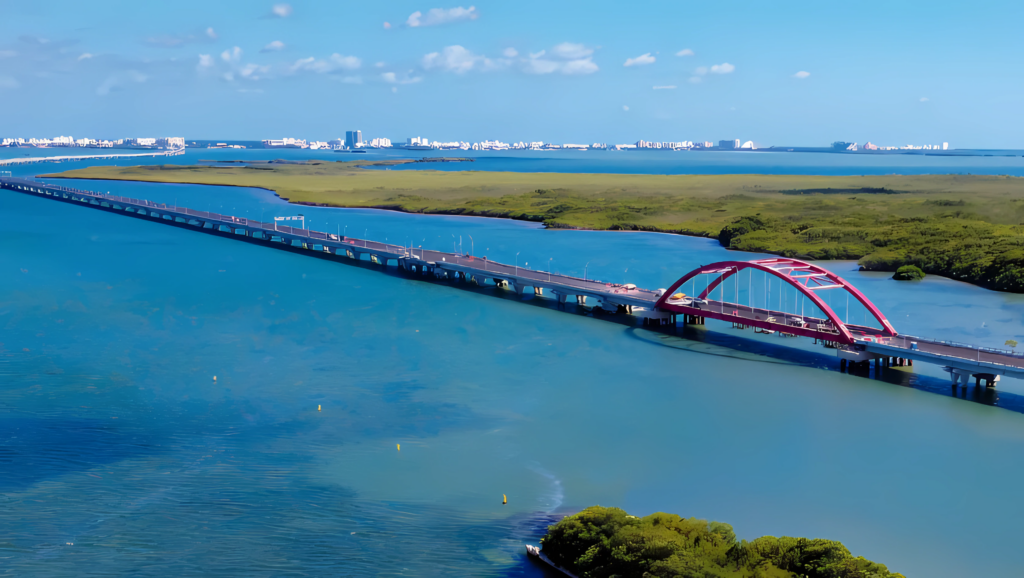
The benefits of the Nichupté Bridge, in the Mexican resort city of Cancún, include a 55-minute reduction in travel time. Additionally, it functions as an evacuation route during hydrometeorological events.
Scheduled for completion in May 2026, this project optimizes the connection between Cancún International Airport and the city’s hotel zone.
The bridge has a total length of 11.2 km. It spans 8.8 km over the Nichupté Lagoon system, an important natural reserve of freshwater and brackish water. It features a 14.9-meter-wide section with three lanes (one of which is reversible). Additionally, the project includes a 103-meter-long steel arch, a bike path, and 660 foundation piers.
Benefits of the Nichupté Bridge
According to the Secretariat of Infrastructure, Communications, and Transportation (SICT), the Nichupté Bridge is a strategic infrastructure project aimed at improving urban mobility and strengthening territorial resilience in one of the country’s most important tourist areas.
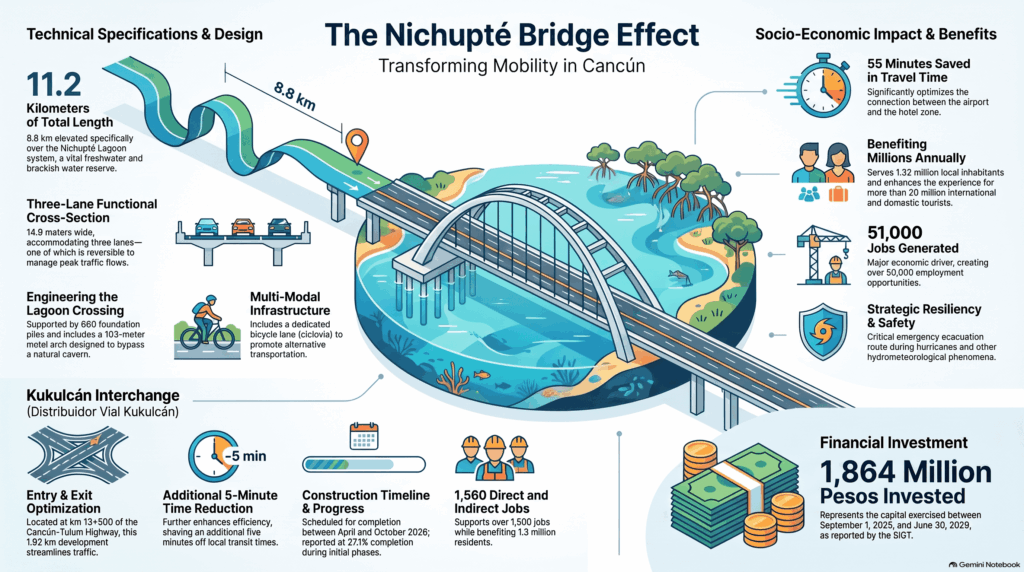
The steel-arch bridge spans a natural cavern along its route and two interchanges, with a total length of 2.4 kilometers.
For this project, and according to the SICT, 1,864 million pesos were spent between September 1, 2025, and June 30, 2026. It also created 51,000 jobs. The project benefited 1.32 million residents and more than 20 million tourists annually. All of this had a social, economic, and environmental impact on the region’s sustainable development.
Kukulcán Interchange
The construction of this interchange, located at km 13+500 on the Cancún–Tulum Highway, will optimize the capacity and efficiency of traffic flow at the entrance and exit of the Nichupté Vehicle Bridge, with a total length of 1.92 kilometers.
This project will enhance safety for residents and in the tourist area. Particularly, it will help in the event of environmental emergencies. It will also reduce travel times by up to five minutes.
The interchange consists of an overpass made up of two separate sections. One section has two lanes of traffic in one direction. The other section has one lane of traffic in the opposite direction.
In addition, the project includes side streets for local services. The project will benefit 1.3 million residents and generate approximately 1,560 direct and indirect jobs. Construction is taking place from April through October 2026. Current progress stands at 27.1 percent.