

Economy Secretary Marcelo Ebrard highlighted the opportunities in electronics manufacturing in North America stemming from growing demand in the region and the interest of U.S. President Donald Trump’s administration in replacing a portion of its foreign purchases of these goods.
In the first half of 2026, the United States imported $43,599 million worth of electronic products. This was a year-over-year increase of 1.4%. This information is according to data from the Department of Commerce.
Electronics Manufacturing in North America
The United States is highly dependent on these goods. For example, a large portion of the electronic components used in the manufacture of car dashboards in the United States are imported from Asia.
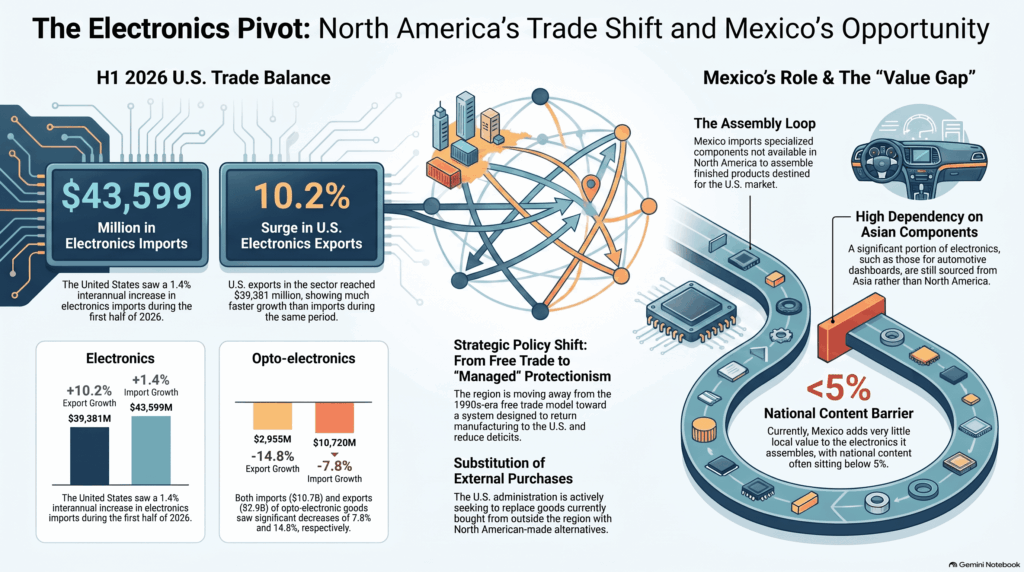
Speaking at the fifth plenary meeting of the Morena party in Mexico City, Ebrard explained that Mexico imports electronic parts and components—which are not available in North America—to incorporate them into finished products sold to the United States.
Some of these Mexican exports of finished products to the U.S. market have low added value. As a result, this increases the U.S. trade deficit with Mexico.
“Your exports are growing even under a very protectionist administration (Trump’s) that opposes the trade deficit, because its own economy is demanding a huge amount of electronic goods that are assembled in Mexico—since we don’t produce them ourselves,” said Ebrard.
He immediately added: “The domestic content of those products has always been very low—perhaps below 5 percent—but it will rise over time.”
U.S. exports of electronic products totaled $39,381 million in the first half of 2026, up 10.2 percent from the same period in 2025.
At the same time, the United States also imported optoelectronic products worth $10,720 million. This was a year-over-year decline of 7.8 percent. Conversely, U.S. exports of these goods totaled $2,955 million. This represented a decline of 14.8 percent.
Trade Policy
Ebrard noted that there has been a shift from a U.S.-driven free-trade system, beginning in the 1990s, to a system organized on the basis of protectionist principles aimed at bringing some manufacturing back to the United States and reducing the U.S. trade deficit with other countries around the world, particularly in Asia.