

The relocation of supply chains is creating opportunities for the pharmaceutical industry in the United States and Mexico.
The pharmaceutical and drug manufacturing industry contributes $655,000 million to the United States’ annual economic output. As a result, the sector plays a key role in the overall performance of the national economy.
Opportunities in the Pharmaceutical Industry
On the one hand, the U.S. market ranges from large multinational companies producing prescription and over-the-counter drugs to firms focused on biologics, vaccines, and generics. It also includes active pharmaceutical ingredient (API) manufacturers and contract development organizations.
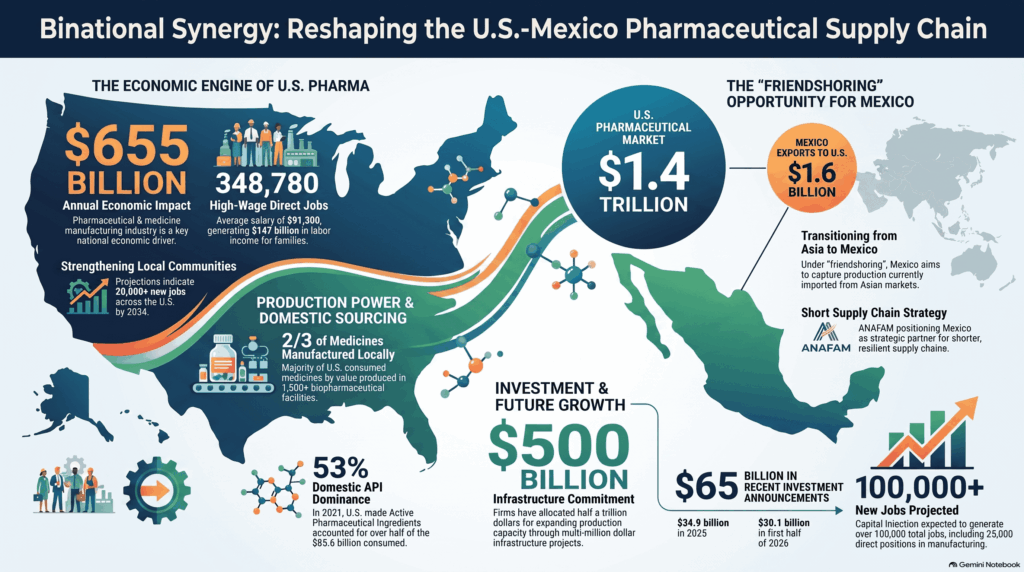
Currently, pharmaceutical manufacturers directly employ 348,780 workers in the United States. With an average annual salary of $91,390, these wages exceed the national average and generate $147,000 million in labor income for families.
Consequently, the sector’s economic impact consistently strengthens local communities. Looking ahead, projections indicate that the industry will create more than 20,000 new jobs nationwide by 2034.
Short Supply Chains
Mexico is part of the “friendshoring” strategy in the manufacturing of pharmaceutical products, the National Association of Drug Manufacturers (ANAFAM) noted in a letter sent to the U.S. Trade Representative (USTR).
Regarding these opportunities, Mexico’s Secretary of Economy, Marcelo Ebrard, said on June 9: “The U.S. pharmaceutical industry is worth 1.4 trillion dollars. How much do we export? Just 1.6 billion dollars.”
Ebrard then added: “What do we expect to happen? That figure will multiply several times over, because the United States is importing a great deal from Asia, and we can produce a portion of it here.”
Investments in the United States
Nearly two-thirds of the medications consumed in the United States are manufactured locally, measured by value. To this end, the sector has more than 1,500 biopharmaceutical production facilities distributed throughout the country, according to the National Association of Manufacturers (NAM).
Likewise, the NAM indicated that domestically produced active pharmaceutical ingredients (APIs) accounted for the largest share of the market in 2021. Specifically, they accounted for 53% of the $85.6 billion spent on medications that year within the country.
Consequently, building on decades of continuous investment, several manufacturers recently announced multibillion-dollar projects in local infrastructure. In total, pharmaceutical companies allocated more than 500,000 million dollars to expand production capacity in the United States.
Ultimately, this significant injection of capital will strengthen the country’s economy and industrial capacity. In addition, the investment is expected to create more than 100,000 new jobs, including 25,000 direct jobs at the plants.
In 2025, the pharmaceutical industry announced new investments totaling $34,900 million. And from January through July 2026, there were announcements totaling another $30,100 million. Not all announcements are always actually carried out.