

Pfizer proposed a pharmaceutical agreement between the United States and Germany as part of the Section 301 investigation being conducted by the White House Office of the United States Trade Representative (USTR).
According to this U.S. multinational pharmaceutical company, Germany undervalues innovative U.S. drugs through comparisons with generics, mandatory discounts, a price freeze in place since 2010, and restrictive clinical criteria. As a result, these measures limit access, reduce returns on innovation, and shift costs to U.S. patients.
Pharmaceutical Agreement
Pfizer stated in a letter to the USTR that an agreement between Germany and the United States—similar to the U.S.-U.K. Pharmaceutical Pricing Agreement—would correct this imbalance.
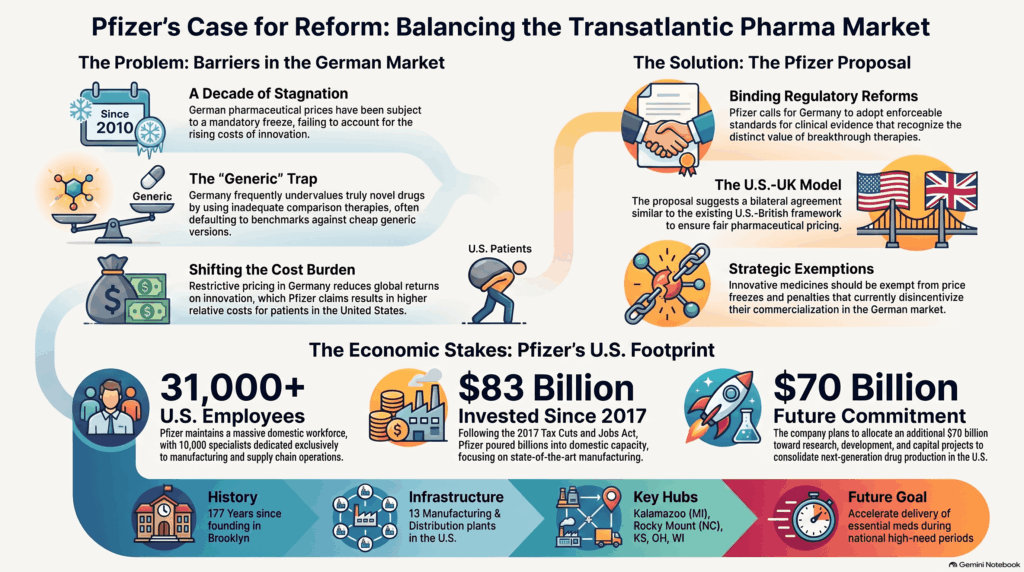
To achieve this, Germany would need to adopt binding and enforceable reforms. These reforms should include appropriate comparator therapies and evidence standards so that truly novel drugs are not automatically compared to a generic. They should also exempt potentially innovative drugs from price freezes and eliminate penalties that discourage their commercialization.
The USTR is conducting a Section 301 investigation into Germany’s persistent underpayment for innovative pharmaceutical products
Company Profile
Pfizer, founded 177 years ago in Brooklyn, operates 13 manufacturing and distribution facilities in the United States. Its main centers are located in Kalamazoo, Michigan, and Rocky Mount, North Carolina. It also maintains specialized facilities in Kansas, Ohio, and Wisconsin.
The company employs more than 31,000 people in the United States, including 10,000 in manufacturing and supply. Following the Tax Cuts and Jobs Act of 2017, Pfizer invested $83 billion in the country.
In addition, it expanded its production capacity in Kalamazoo, Michigan, and Sanford, North Carolina. Pfizer plans to allocate another $70 billion to research, development, and capital projects. The plan includes consolidating the manufacturing of cutting-edge medications within the United States.
With these investments, Pfizer has developed one of the largest domestic pharmaceutical manufacturing networks in the country. The company noted that it seeks to accelerate the delivery of essential medications—especially during periods of high national need—through increased production and supply capacity.
Pfizer also stated that it was the first company to negotiate an agreement with the U.S. government to reduce drug prices. The initiative aims to lower costs for U.S. patients and rebalance the prices that other countries pay for these products.