

The Mexican Automotive Industry Association (AMIA) highlighted three benefits of the USMCA’s automotive rules of origin.
The USMCA contains strict rules of origin for qualifying for tariff benefits in trade between Mexico, the United States, and Canada.
Benefits of the Rules of Origin
In a letter addressed to U.S. Trade Representative Jamieson Greer, AMIA Executive President Rogelio Garza explained that the U.S.-Mexico-Canada Agreement’s (USMCA) entry into force brought about a significant increase in Regional Value Content (RVC). In addition, he mentioned new requirements for labor content and steel and aluminum procurement. He emphasized that, in light of these requirements—the strictest of any trade agreement—various producers and suppliers have invested and worked hard to meet them.
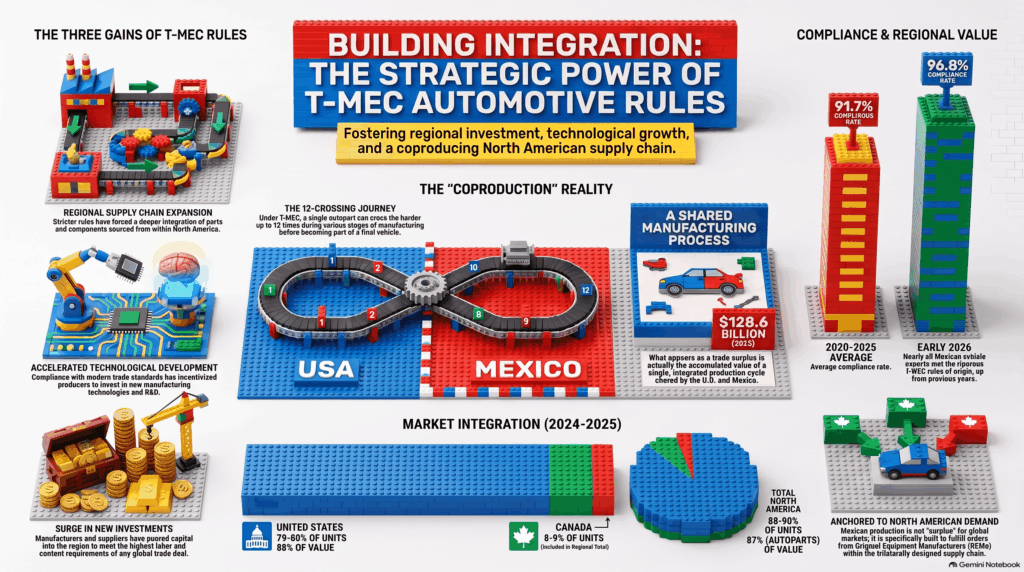
Garza noted that this generates the following three additional benefits for the region:
- Expansion of the regional supply chain.
- Technological development.
- New investments.
Garza’s statement came in the context of an investigation by the U.S. government into 16 trading partners. The investigation examines whether these countries “have structural excess capacity and production in various manufacturing sectors.” These trading partners are China, the European Union, Singapore, Switzerland, Norway, Indonesia, Malaysia, Cambodia, Thailand, South Korea, Vietnam, Taiwan, Bangladesh, Mexico, Japan, and India.
Automotive Production in North America
Rules of origin are laws, regulations, and procedures used to determine the country of origin of imported products. Moreover, they can also serve as a trade policy tool to support strategic objectives, such as strengthening regional supply chains.
Garza argued that compliance with rules of origin can also serve as an indicator of how automotive companies are increasing their production in North America and becoming less dependent on products and inputs from outside the region.
Supply Chain
In this regard, the average percentage of Mexican passenger vehicle and light truck exports that comply with the USMCA’s rules of origin stood at 91.7% between 2020 and 2025. Additionally, it reached 96.8% in the first two months of 2026.
This clearly reflects a high proportion of regional value content. Furthermore, it explains that the increase in Mexico’s exports to the United States is the result of an integrated North American supply chain. It is not due to subsidized overproduction.
For Garza, all of this demonstrates the transformative trend the automotive supply chain is undergoing in the region, which seeks to achieve higher levels of integration.