

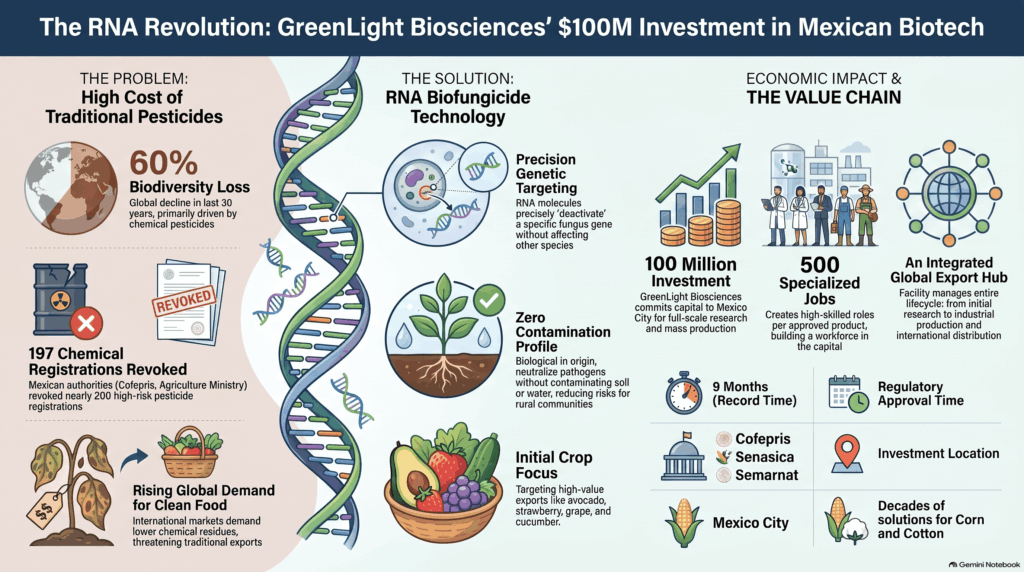
GreenLight Biosciences will invest up to $100 million in Mexico City to produce the world’s first RNA biofungicide.
This project will create 500 direct, specialized jobs in the country’s capital (50 for each approved product, plus equivalent support staff).
GreenLight Biosciences
In a record time of nine months, the Mexican government granted official registration for this technological development. As a result, the new plant will integrate the entire value chain, encompassing research, mass production, and international export.
Unlike traditional chemical pesticides, this biologically derived product uses RNA molecules to neutralize pathogens without causing contamination. Consequently, it reduces risks for agricultural workers, consumers, and rural communities.
The news was announced this Wednesday at an event led by Economy Secretary Marcelo Ebrard in Mexico City.
There, Andrey Zarur, CEO of GreenLight Biosciences, announced that they will begin with two biofungicides for avocados, strawberries, grapes, and cucumbers. Subsequently, the company plans to develop dozens of solutions for corn and cotton crops.
The authorization was granted by the Federal Commission for Protection against Health Risks (Cofepris), the National Service for Agrifood Health, Safety, and Quality (Senasica), and the Ministry of the Environment and Natural Resources (Semarnat).
High-Risk Pesticides
Víctor Hugo Borja Aburto, head of Cofepris, said that the world is restricting high-risk pesticides. “Cofepris and the Ministry of Agriculture have revoked 197 registrations, and a second decree on banned pesticides is about to be published,” he added.
At the same time, international markets are demanding ever-lower levels of chemical residues in food.
Biotechnology vs. Nearshoring
RNA molecules function as a targeted treatment that “deactivates” a specific gene the fungus needs to survive, without polluting the environment or posing significant risks to people or other species.
According to Zarur, global biodiversity has declined by 60% over the past 30 years, and one cause of this is the millions of metric tons of pesticides used annually.
“André isn’t waiting for nearshoring, nor is he watching to see what happens with tariffs next week (sic). He’s not caught up in that anxiety; I don’t see him that way. What is he focused on? On producing what we need so that our economy can grow and we can achieve greater value added. And these ideas, this knowledge, will generate wealth for Mexico,” Ebrard commented.