

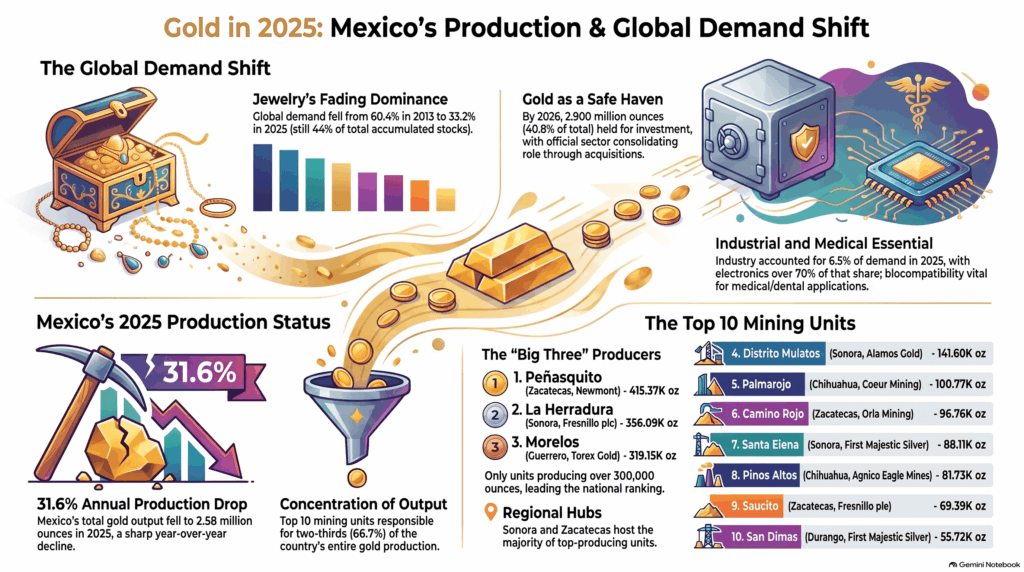
Mexican gold production recorded a year-over-year decline of 31.6% in 2025, falling to 2.58 million ounces.
Of that total, the top 10 gold-producing mining operations accounted for 66.7% of production.
Today, gold is used both as a raw material and as a store of value. As a raw material, it is primarily used in jewelry and industrial products. As a store of value, it constitutes the gold holdings of the official sector and private investors.
Jewelry Leads Historical Demand for Gold
Jewelry remains the primary use of gold globally. In 2025, it accounted for 44% of global stocks. However, its relative share fell from 60.4% in 2013 to 33.2% in 2025, according to industry data.
In developed countries, gold is purchased for its design; in emerging economies, it is also purchased as a store of value. India, East Asia, and the Middle East lead the demand. There, gold pieces have a higher karat weight and better reflect the metal’s price.
6.5% of gold demand in 2025 came from industry, primarily electronics (more than 70% between 2010 and 2025). Furthermore, its biocompatibility makes it essential for medical and dental applications, although demand in these areas is declining slightly.
Investment and official reserves sustain the market
By 2026, 2,900 million ounces of gold remain held as an investment, accounting for 40.8% of the total. Less than half is held by the official sector, which acquired 29.3 million ounces that year, solidifying gold’s role as a safe-haven asset.
Mexican Gold Production
Newmont’s Peñasquito mine is located in Zacatecas and produced 415,370 ounces. In second place is Fresnillo plc’s La Herradura mine in Sonora, with 356,090 ounces. Torex Gold’s Morelos mine is located in Guerrero and recorded 319,150 ounces.
Alamos Gold’s Distrito Mulatos operates in Sonora and produced 141,600 ounces. Coeur Mining’s Palmarejo is located in Chihuahua and produced 100,770 ounces. Orla Mining’s Camino Rojo is in Zacatecas and produced 96,760 ounces.
First Majestic Silver’s Santa Elena is located in Sonora and produced 88,110 ounces. Agnico Eagle Mines’ Pinos Altos operates in Chihuahua, producing 81,730 ounces. Saucito, also owned by Fresnillo plc, is in Zacatecas and produced 69,390 ounces.
Finally, San Dimas, owned by First Majestic Silver, is located in Durango and produced 55,720 ounces. Thus, these ten mining operations account for the majority of gold production in Mexico, distributed across Zacatecas, Sonora, Guerrero, Chihuahua, and Durango.