
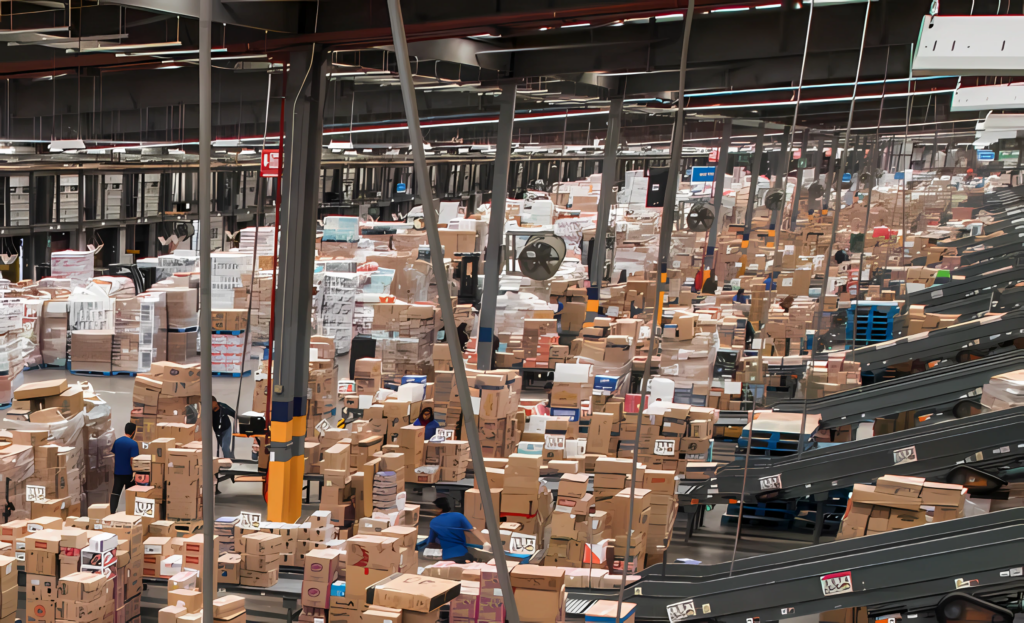
Walmart and artificial intelligence (AI) have formed a new partnership. To some extent, this partnership has enabled the company’s subsidiary to increase its revenue in recent years.
Walmart de México y Centroamérica (Walmex) has reduced its days of inventory on hand. This was achieved through better overall coordination and initiatives that improve store productivity.
An AI-based inventory health model now distinguishes between healthy and unhealthy inventory. It also provides visibility into root causes for the replenishment, merchandising, and sales teams. It also dynamically adjusts healthy days of coverage.
Walmart and Artificial Intelligence
AI is a broad term that refers to algorithms and techniques designed to give computer systems the ability to learn new concepts or tasks. Furthermore, AI aims to enable systems to reason and solve complex problems in a manner similar to human intelligence.
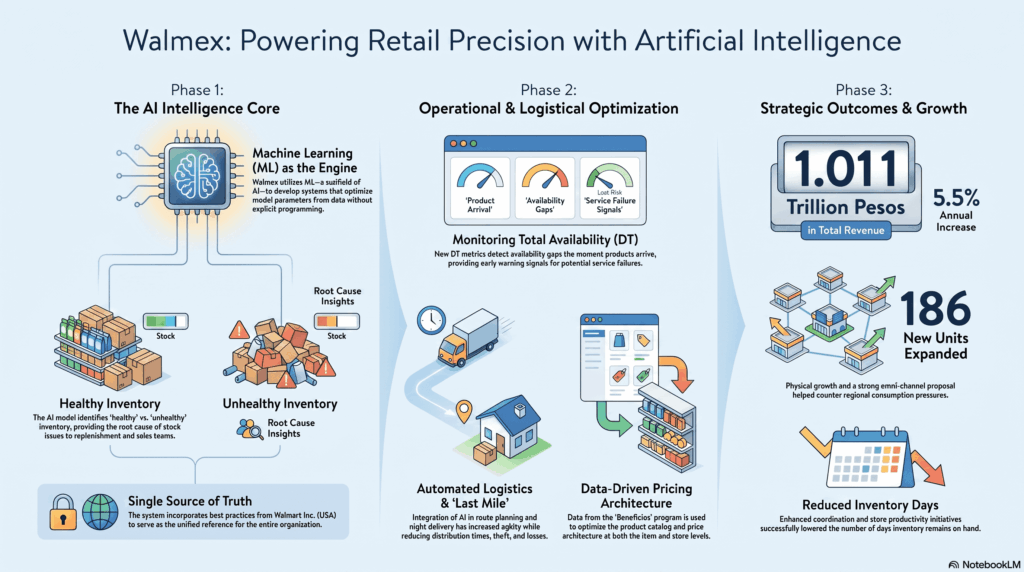
Walmex’s AI-based inventory health model also predicts excess and shortage levels—both in units and monetary value—while optimizing safety stock thresholds.
This model serves as a single source of truth for the organization, incorporating Walmart Inc.’s best practices from the U.S. market.
Industrial Automation
To strengthen product availability, the company implemented new Total Availability (TA) metrics that monitor performance across the entire supply chain.
This measurement approach detects availability gaps from the moment the product arrives. As a result, it provides early warnings of potential service failures and improves operational discipline.
Walmex’s logistics platform has become more agile and automated. Advances in automation, artificial intelligence, route planning, and nighttime delivery capabilities have strengthened both first-mile and last-mile operations. These advances also reduce losses, theft, and distribution times, thereby contributing to a more resilient and efficient supply chain.
Machine Learning (ML) is generally considered a subfield of AI focused on developing systems that can learn (i.e., optimize model parameters) from data without explicit programming.
Data generated through Walmex’s “Beneficios” program is already being leveraged to improve pricing architecture and optimize catalog productivity at both the item and store levels.
In 2025, the company reported total revenue of 1 trillion 011,598 million pesos, a year-over-year increase of 5.5%. This growth was driven by the expansion of 186 stores and the strength of its omnichannel strategy, which offset pressures on regional consumption.
The following table shows Walmex’s revenue trend in billions of pesos:
- 2021: 736.
- 2022: 819.
- 2023: 887.
- 2024: 959.
- 2025: 1,012.
Competition
It competes intensely with chains such as Soriana, Chedraui, and Costco, as well as neighborhood convenience stores like Oxxo. In the digital sphere, it faces giants such as Amazon and Mercado Libre. This environment requires constant differentiation based on low prices and technological expansion.