

The Chinese Ministry of Commerce denied that there is insufficient domestic demand in China and that this leads to overcapacity.
In a document released on Tuesday, it argued that China is not only a manufacturing powerhouse but also a major consumer market.
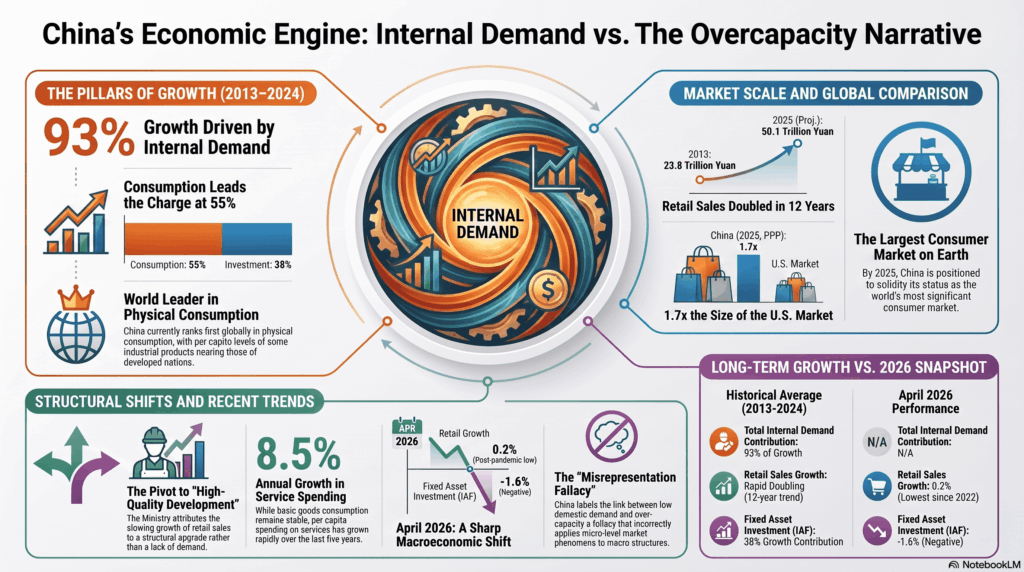
Domestic demand has consistently been the main driver of the Chinese economy, contributing an average of 93% to the country’s economic growth between 2013 and 2024.
Of this total, the Ministry of Commerce indicated that consumption and investment contributed an average of 55% and 38%, respectively.
This official narrative reinforces the geopolitical struggle between Beijing and the West over industrial overcapacity. By defending the strength of its domestic market, China justifies its massive exports. Furthermore, it challenges U.S. pressure and tariff restrictions under multilateral rules.
Insufficient Domestic Demand in China
Total retail sales of consumer goods in China doubled, rising from 23.8 trillion yuan in 2013 to 50.1 trillion yuan in 2025. Adjusted for purchasing power parity as calculated by the World Bank, China’s total retail sales in 2025 will be 1.7 times greater than those of the United States, making it the world’s largest consumer market.
China currently ranks first in the world in terms of physical consumption. Its annual per capita consumption of certain industrial products is approaching the levels seen in developed countries.
In recent years, according to the Ministry of Commerce, the growth rate of China’s total retail sales has slowed. This is consistent with China’s economic shift from rapid growth to high-quality development. It also reflects the trend toward an improvement in China’s consumption structure.
Retail Sales
The stagnation in consumption and the decline in investment in China during April 2026 signal a marked shift from the relatively robust macroeconomic landscape of the first quarter.
On the consumption front, retail sales grew by 0.2% year-over-year, the lowest monthly figure since December 2022. That month marked the end of the “Zero-Covid” policies, according to the U.S.-China Economic and Security Review Commission.
At the same time, consumer prices rose after remaining near 0% for three consecutive years. As for investment, fixed asset investment (FAI) turned negative in April. There was a cumulative year-over-year decline of 1.6%. Last year, FAI was negative for the first time in more than three decades.
The slowdown in demand for credit from households and businesses points to a further moderation in both consumption and investment in the second half of the year.
Chinese Domestic Market
While consumption of basic goods has remained relatively stable, consumption of services has grown rapidly. Per capita spending on services has grown at an average annual rate of 8.5% over the past five years.
According to the Ministry of Commerce, attributing the slowdown in China’s retail sales growth to insufficient domestic demand is neither objective nor comprehensive. Furthermore, the argument that “insufficient domestic demand in China leads to overcapacity” is a “fallacy of misrepresentation.” This applies micro-level market phenomena to the macroeconomic structure.