
A primary target in answering the question “What is Section 338, and how does Donald Trump intend to use it to impose tariffs?” is Canada.
On July 20, Trump issued three proclamations under Section 338 of the Tariff Act of 1930, imposing an additional 50% ad valorem tariff on imports of wine, fishing rods, furniture, textiles, hockey sticks, cement, and other goods from Canada as a trade retaliation measure.
What is Section 338?
Section 338 of the Tariff Act of 1930—Tariffs to Counter Discrimination Against the United States—allows for the imposition of tariffs of up to 50 percent, with no time limit. This provision has never been used. To implement it, the Office of the United States Trade Representative (USTR) is required to issue findings.
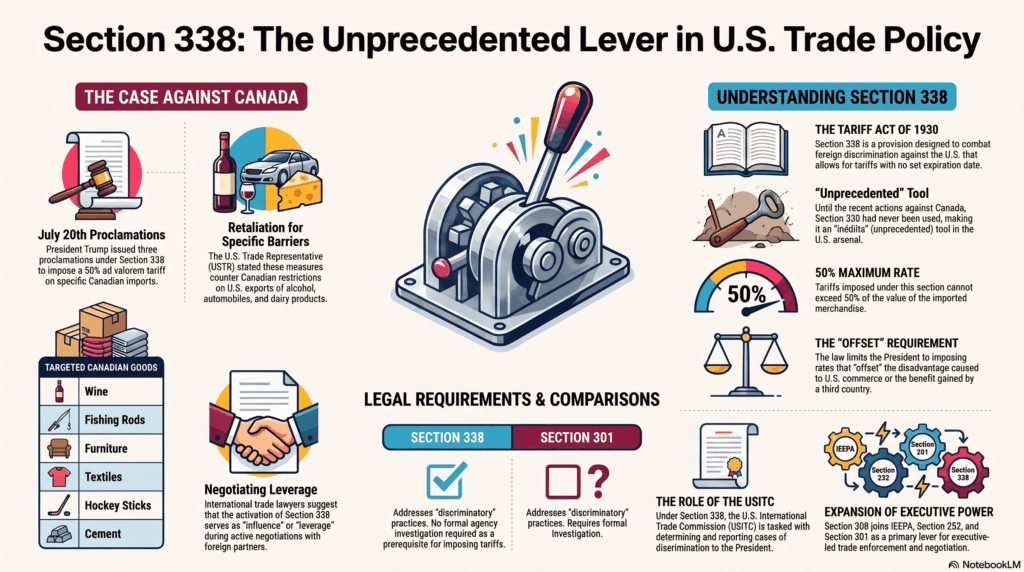
Some international trade lawyers note that the law has occasionally been used as a means of “leverage” in negotiations with other countries.
Some press reports indicate that Section 338 could be a potential tool for the Trump Administration to impose tariffs in response to tariffs and non-tariff barriers imposed by other countries.
The USTR noted that these measures are intended to counteract the restrictions imposed by Canada on U.S. imports of alcohol, automobiles, and dairy products. It also emphasized that they are being implemented based on broad legal authorities—never before used—to address trade discrimination against U.S. exporters.
Trade Discrimination
The President’s authority under Section 338 appears to overlap with that of the USTR under Section 301 of the Trade Act of 1974, which also authorizes tariffs in response to certain “discriminatory” practices by foreign countries.
According to an analysis by the U.S. Congress, unlike Section 301, Section 338 does not appear to require any investigation or determination by the agency as a prerequisite for imposing tariffs. Section 338 entrusts the U.S. International Trade Commission (USITC) with the task of “determining” and reporting to the President on relevant cases of discrimination.
U.S. President Donald Trump has used tariffs as a bargaining chip since the start of his second term. To this end, he has relied on the IEEPA, Section 232 tariffs, and Section 301 tariffs. This time, however, the administration has activated an unprecedented tool.
Tariffs under Section 338 may not exceed 50 percent of the value of the goods. Certain language in Section 338 also appears to limit the President to imposing additional tariff rates that will “offset” either the burden or disadvantage to U.S. trade or the benefit to a third country resulting from the foreign measures in question.