

The Toy Association emphasized that tariffs on toy imports into the United States affect U.S. employment.
Consequently, the association concluded that revoking normal and permanent trade relations with China or imposing higher tariffs would have lasting negative consequences for the U.S. toy industry.
From its perspective, past trade tensions have already demonstrated how restrictive policies can disrupt supply chains and increase costs. Furthermore, further escalation would intensify and exacerbate these challenges for the sector.
Tariffs on Toy Imports
Given that the U.S. toy industry relies heavily on efficient, large-scale production and global sourcing, The Toy Association believed that higher tariffs would increase the cost of imported toys and essential components, forcing companies to make difficult decisions.
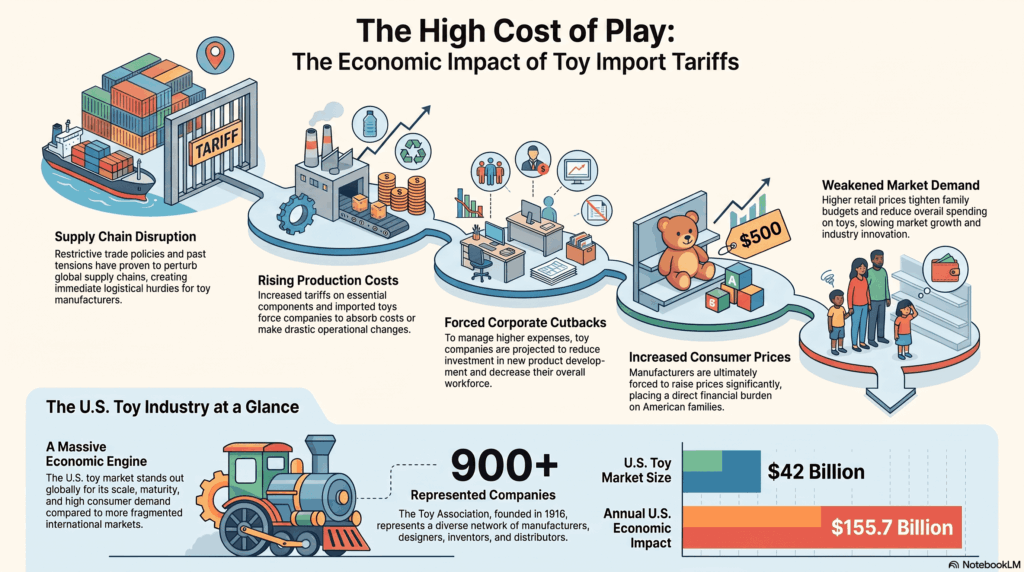
It also projected that toy companies would be forced to significantly raise prices, reduce investment in new products, and cut their workforce.
At the same time, The Toy Association added that higher prices would strain family budgets and reduce overall spending on toys, weakening demand across the entire market.
At the same time, The Toy Association added that higher prices would strain family budgets and reduce overall spending on toys. As a result, it would weaken demand across the entire market.
Overall, the association argued that these effects would slow growth, reduce innovation, and diminish the strength and competitiveness of the U.S. toy industry. Moreover, American families and workers tied to the industry would bear the brunt of the consequences.
Industry Profile
Founded in 1916, the Association today represents more than 900 companies, including manufacturers, designers, engineers, inventors, product quality and safety testing laboratories, and distributors. Their products and services drive a $42,000 million U.S. toy market. In addition, they contribute to an estimated annual economic impact of $155,700 million in the United States.
Compared to other regions, the U.S. toy market stands out for its scale, maturity, and strong consumer demand. Meanwhile, many other markets are more fragmented, more price-sensitive, or still in earlier stages of growth.