
The Global Electronics Association has asked President Donald Trump’s administration to exempt imports of electronic components from tariffs. It has done so as part of ongoing investigations by the United States Trade Representative (USTR).
These are Section 301 investigations into various economies. These investigations relate to the failure to effectively impose and enforce a ban on the importation of goods produced under conditions of forced labor.
Imports of Electronic Components
The United States is a net importer of electronic components out of necessity, not by choice. The Global Electronics Association’s trade analysis shows that U.S. imports of electronic components reached $231,000 million in 2023. Furthermore, in 2024, they totaled $270,000 million, a 41% increase from 2017. This occurred because advanced electronics cannot be manufactured without globally sourced components.
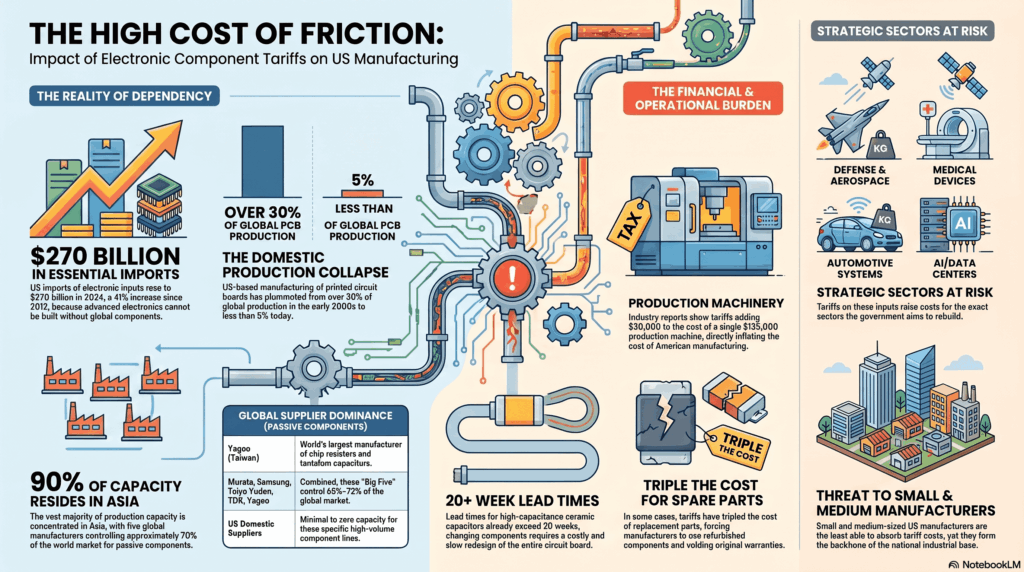
For the product lines in question, there is no domestic capacity to fall back on. In fact, the manufacture of printed circuit boards in the United States has fallen from more than 30% of global production in the early 2000s to less than 5% today. Furthermore, more than 90% of production capacity is located in Asia.
Passive components under headings 8532 and 8533 are manufactured almost entirely in Japan, South Korea, and Taiwan. The five largest manufacturers—Murata, Samsung Electro-Mechanics, Taiyo Yuden, TDK, and Yageo—control approximately 68% to 72% of the global market. Furthermore, Taiwan’s Yageo is the world’s largest manufacturer of chip resistors and tantalum capacitors.
Limited Domestic Production
The Global Electronics Association argued that a U.S. manufacturer facing a tariff on these lines has no domestic supplier to turn to.
Many of these components also currently enter the U.S. at a free or near-zero most-favored-nation (MFN) rate. For example, bare printed circuit boards under heading 8534.00.00 are exempt from tariffs. Therefore, the proposed tariff would represent an entirely new cost for an input that was previously untaxed.
A single assembled board contains hundreds of these components, often priced in cents, each essential to its function. Lead times for high-capacitance ceramic capacitors already exceed 20 weeks, and redesigning a board around a different component footprint is costly and time-consuming.
The loss of competitive cost access to even a single part can paralyze an entire production line.
Manufacturing Costs
The companies least able to absorb this impact are small and medium-sized U.S. manufacturers, which make up the bulk of the domestic manufacturing base. The sectors that depend on these inputs—defense electronics, aerospace, medical devices, automotive systems, and AI and data center hardware—are the strategic industries the Administration is working to rebuild.
A tariff on inputs raises the cost of the very production that this measure is intended to protect. For this reason, the implications of broad-based tariffs would also affect equipment vital to sustaining U.S. manufacturing.
Association members report that tariffs are already directly increasing the cost of production and maintenance equipment. In fact, in one case, a company cited $30,000 in tariffs on the purchase of a $135,000 machine.
In another case, it was reported that tariffs on a replacement part tripled its cost, forcing the company to purchase a remanufactured part and voiding the original manufacturer’s warranty. Such disruptions can paralyze production lines rather than facilitate relocation in the short term.
The Global Electronics Association represents more than 3,000 companies in the electronics sector and supports a strict and enforceable ban on forced labor, and urges the USTR to adopt specific, risk-based, and incentive-aligned measures.
Industrial Policy
In macroeconomic terms, imposing tariffs on these imports raises systemic costs, makes final production more expensive, and reduces margins in highly integrated supply chains. The result can be reduced industrial competitiveness, increased inflationary pressure, and delays in strategic sectors that depend on specialized inputs.
The Trump Administration aims to protect and incentivize U.S. production of certain strategic inputs and components.
From an industrial perspective, the tariff creates friction in sectors where there is no immediate domestic substitute. For manufacturers and suppliers, the priority is no longer just compliance, but ensuring operational continuity, maintaining delivery times, and protecting critical installed capacity.