
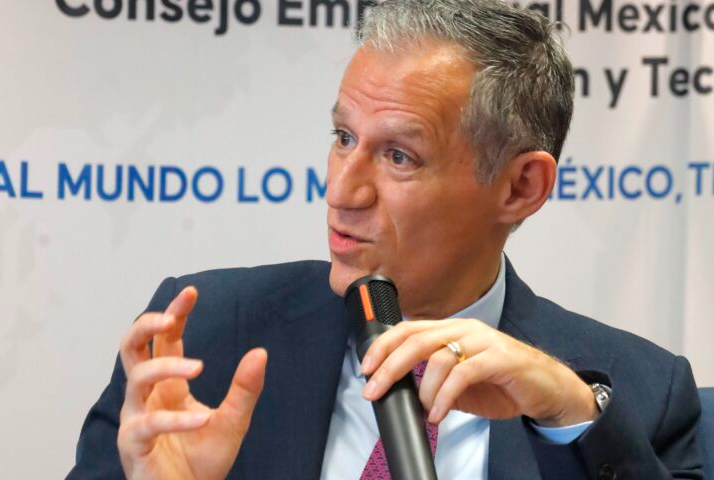
Jamieson Greer, the U.S. Trade Representative, must take a hard line in the USMCA negotiations. This was emphasized by Kenneth Smith, president of the U.S.-Mexico Business Committee of COMCE.
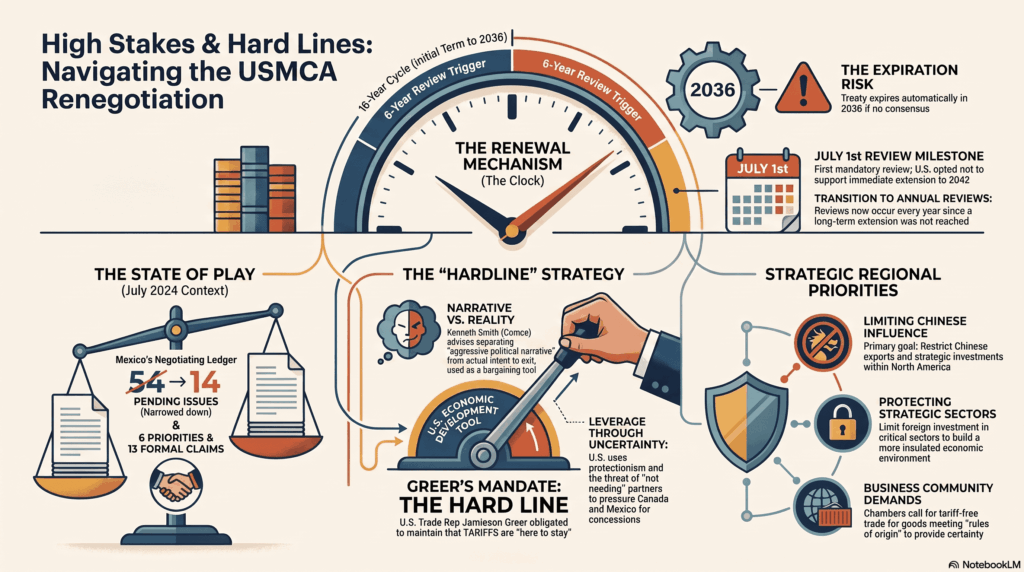
The USMCA is at a decisive stage: following the first mandatory joint review on July 1, the United States did not support immediately extending it through 2042, and the treaty will remain in effect, with annual reviews and a third round of bilateral talks on July 20. Mexico is entering this phase with six priorities, 13 claims, and a reduction in outstanding issues with the United States from 54 to 14.
Negotiating Tool
“If we look at the statements made by the U.S. government when President (Donald) Trump returned to power in January 2025, he spoke of uncertainty and whether or not the treaty would exist. In fact, he has recently said that (the United States) doesn’t need Canada, doesn’t need Mexico,” Smith said Thursday at a press conference.
Trump combines protectionism, tariffs, and threats as a negotiating tool. Its effectiveness is limited: it applies pressure, reshapes markets, and secures specific concessions. However, it also drives up costs, provokes retaliation, and often, his warnings amount to more political noise than lasting change.
“Since we—and all of you—already have experience with President Trump’s statements, we need to set aside the aggressive political rhetoric. Furthermore, President Trump consistently uses this as a negotiating tool to say, ‘I don’t need you, but I’m willing to sit down at the table.’ This does not mean that the United States is withdrawing from the treaty,” Smith added.
Hard Line in USMCA Negotiations
Business chambers called for extending and strengthening the USMCA. They also requested that goods meeting the rules of origin remain tariff-free. In this way, they seek to provide certainty, preserve investments, and prevent the review from leading to further trade uncertainty.
Referring to the U.S. negotiators, Smith said, “Unfortunately, they claim that the objectives the United States set for itself in this agreement have not been met.” But he then contradicted himself: “(The USMCA) has greatly benefited all three countries.”
Greer is leading the U.S. trade strategy for the USMCA review. He coordinates negotiations with Mexico and Canada, advocates for the agreement to strengthen regional competitiveness, pushes for changes favorable to the United States, and keeps open the possibility of substantial modifications during the review.
Smith stated that the United States seeks to build a North American economic environment. To achieve this, it is pushing for restrictions on Chinese exports to the region. In addition, it aims to limit Chinese investments in sectors that the Trump administration considers strategic for national security.
“(Greer) has an obligation to take a hard line—to say that tariffs are here to stay or that tariffs are a useful tool for U.S. development. These are claims that, in practice, have not been proven and will not be proven. However, the U.S. Trade Representative has an obligation to take that line,” Smith said.
Renewal Process
The USMCA entered into force on July 1, 2020, with an initial term of 16 years, through 2036. It is reviewed every six years. If there is no consensus, the agreement remains in effect but will automatically expire in 2036 if not renewed. Furthermore, if all parties agree to continue it, it will remain in effect for another 16 years. If a party does not confirm its desire to extend the agreement for another 16-year period, the parties will conduct a joint review of the agreement each year.
If all three countries decide to extend it, the USMCA will be extended for 16 years from that point and will not be reviewed again until six years later.