
The Mexican government highlighted the main trade concerns between the United States and Mexico in a document sent to the Mexican Congress on Wednesday.
This is the Report on the Status of the Review Process of the United States-Mexico-Canada Agreement (USMCA). The Ministry of Economy submitted this report to the Permanent Commission.
Trade Concerns Between the United States and Mexico
According to the document, the issues raised by the United States for review relate primarily to job losses in certain manufacturing sectors, high dependence on third countries in supply chains, the trade deficit, rules of origin, and economic security.
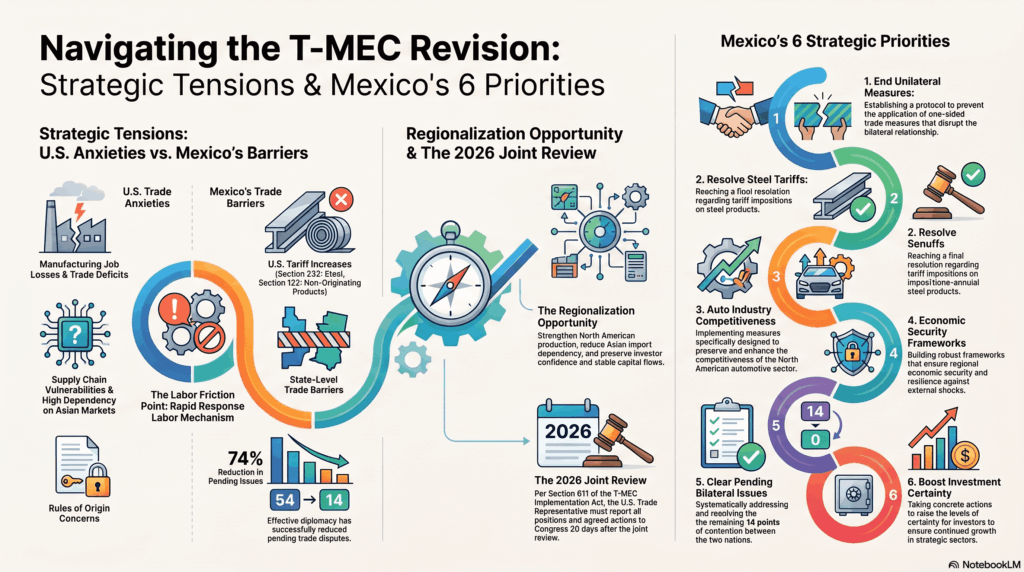
For its part, the Ministry of Economy stated that significant progress has been made in these talks. In recent months, the number of pending issues has dropped from 54 to 14. From Mexico’s perspective, these issues can be addressed through a regional strategy. Such a strategy will strengthen production in North America and reduce dependence on imports from Asia.
State-Level Barriers
In turn, Mexico presented 13 points outlining trade concerns under the USMCA. These points include U.S. tariff increases on strategic industries under Section 232 and on non-USMCA-origin products under Section 122. In addition, there are restrictions in specific sectors, the use of the Rapid Response Labor Mechanism, and trade barriers at the state level.
“Mexico has emphasized that these measures represent significant obstacles to bilateral trade and require immediate attention to maintain the balance of the trade relationship between the two countries,” the document adds.
Regionalization of Trade
In April 2026, the Ministry of Finance and Public Credit presented the Preliminary General Economic Policy Guidelines for 2026. The document includes macroeconomic and public finance projections for the end of 2025, as well as projections for 2026.
The analysis warns that the international environment continues to pose significant risks to the Mexican economy. However, it also highlights a structural opportunity: the regionalization of trade. In this context, it is important to strengthen long-term economic integration with the United States and Canada. Furthermore, effectively resolving trade disputes under the USMCA is key to maintaining investor confidence. This ensures stable capital flows to strategic growth sectors.
Reports in the United States
Furthermore, no later than 20 days after the USMCA countries hold a joint review, the White House Office of the United States Trade Representative must report to the relevant congressional committees. The report must detail the positions expressed during that review and any actions the countries may have agreed upon. This is established in Section 611 of the USMCA Implementation Act.