
The United States remained at the top of the ranking of the world’s leading economies in FDI in 2025, with $270,000 million, UNCTAD reported on Tuesday.
It was followed by Singapore, Hong Kong, China, Brazil, the United Kingdom, Germany, Canada, the United Arab Emirates, and Mexico.
World’s Leading Economies in FDI in 2025
The United States led global FDI inflows with $277 billion, driven by megaprojects in strategic manufacturing and digital infrastructure. Its dominance stems from active industrial policies that anchor investment in cutting-edge technologies to ensure its economic security.
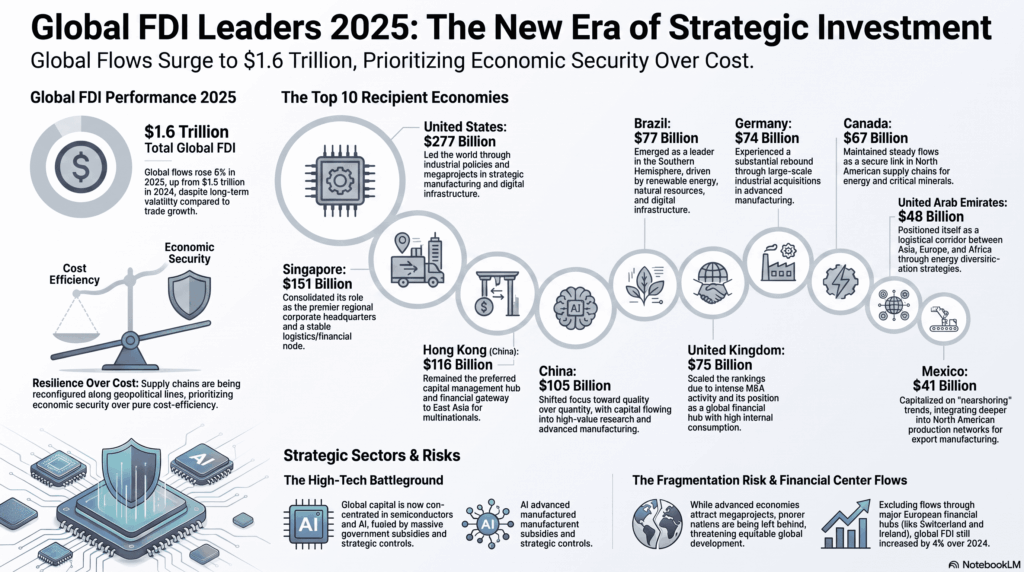
In Asia, Singapore solidified its second-place position with $151,000 million, reaffirming its role as a regional corporate hub. Its added value lies in providing a stable financial and logistical hub, vital for cross-border capital flows.
Advanced Manufacturing
For its part, Hong Kong (China) attracted $116 billion, maintaining its status as a financial gateway to East Asia. Strategically, it remains the preferred capital management hub for multinationals seeking to connect with regional markets.
In contrast, China received $105,000 million, reflecting a deliberate shift toward quality over quantity. Its investment flows are now strategically focused on high-value sectors, such as scientific research and advanced manufacturing.
In Latin America, Brazil stood out with $77,000 million, driven by the boom in renewable energy and natural resources. The country is positioning itself as a key destination for major digital infrastructure projects in the Southern Hemisphere.
Meanwhile, the United Kingdom climbed the rankings with $75,000 million, thanks to intense merger and acquisition activity. Its market acts as a strategic magnet, combining strong domestic consumption with a global financial hub.
Critical minerals
Following this trend, Germany recorded a substantial uptick of $74,000 million through large-scale industrial acquisitions. Its renewed appeal underscores investor confidence in the competitiveness of its advanced manufacturing ecosystem.
On the North American front, Canada maintained stable investment flows of $67,000 million directed toward energy and critical minerals. Strategically, it is consolidating its position as an essential and secure link within North America’s integrated supply chains.
Meanwhile, the United Arab Emirates attracted $48,000 million through its ambitious energy diversification strategy. The country has positioned itself as a key logistics and technology hub linking the markets of Asia, Europe, and Africa.
Finally, Mexico rounded out the top ten with $41,000 million, capitalizing on the restructuring of supply chains through nearshoring. Its strategic integration into North American production networks ensures sustained growth in services and export manufacturing.
Semiconductors and Artificial Intelligence
According to UNCTAD, global capital is now concentrated in strategic sectors such as semiconductors and artificial intelligence. These capital flows no longer seek only efficiency, but also economic security and technological leadership. Competition among major powers is redefining investments through massive subsidies and strategic controls.
The reconfiguration of supply chains follows geopolitical and regional lines, prioritizing resilience over cost. While advanced economies attract megaprojects, poorer countries are marginalized. This fragmentation weakens international cooperation and threatens equitable global development.