

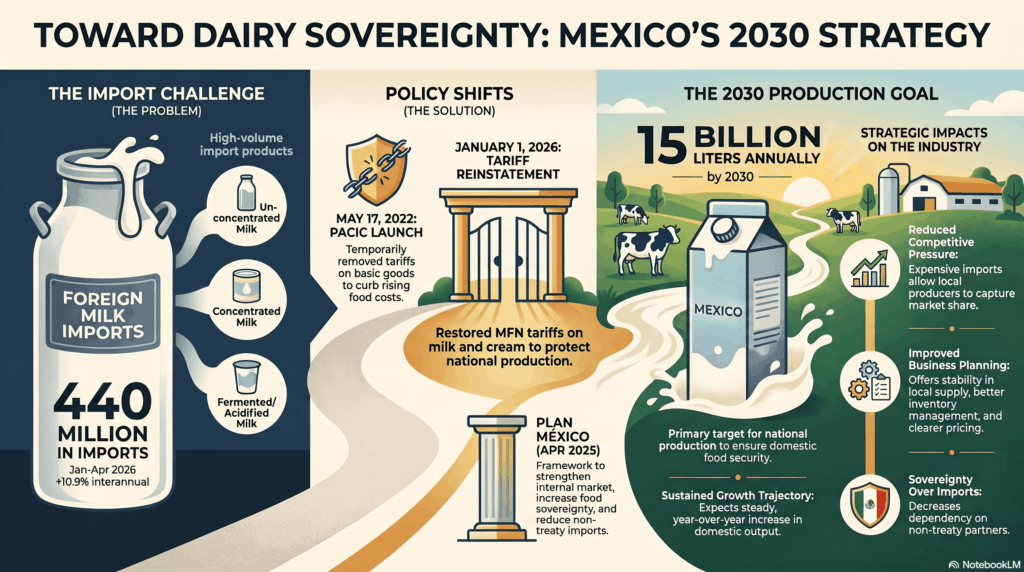
The Mexican government reinstated tariffs on milk imports as of last January to stimulate milk production in Mexico.
This measure aims to advance toward the goal of increasing domestic production of this staple product to 15,000 million liters annually by 2030. A sustained increase in production is expected.
Milk Production in Mexico
Mexican milk imports totaled $440 million from January through April 2026, a year-over-year increase of 10.9 percent. These imports include non-concentrated, unsweetened milk; concentrated milk with or without sugar; and fermented, acidified milk with sugar.
Mexican milk imports, in millions of dollars, are as follows:
- 2018: 793.
- 2019: 945.
- 2020: 849.
- 2021: 1,090.
- 2022: 1,523.
- 2023: 1,213.
- 2024: 1,144.
- 2025: 1,227.
Combating Inflation
The Package Against Inflation and Shortages (PACIC) aims to reduce inflation and stem the decline in domestic consumption by temporarily eliminating import tariffs on goods included in Mexico’s basic basket of goods. In effect since May 17, 2022, this package has undergone several modifications; the most recent one dates from December 31, 2025.
On April 3, 2025, the “Plan México: Strengthening the Economy and Well-being” was announced, with the following objectives: to strengthen the domestic market and wages; to increase food and energy sovereignty; to boost domestic production and reduce imports from countries with which Mexico has no trade agreements; and to consolidate the Well-being Programs.
Agricultural Products
In compliance with the PACIC Renewal Agreement and following an analysis of the inflationary pressures causing instability in the prices of basic food basket items, as well as the growth rate of imports from countries without a free trade agreement with Mexico, the government deemed it necessary to review the appropriateness of maintaining tariff exemptions on certain products.
However, to that end—and with the goal of increasing domestic milk production by up to 15,000 million liters annually by 2030—it was deemed necessary to eliminate the tariff exemptions applied to that product.
Consequently, under the PACIC framework, tariffs on various essential food items, including cream, were temporarily reduced to zero as a measure to combat food price inflation.
Effective January 1, 2026, Mexico reinstated MFN tariffs on imports of various agricultural products—including milk and cream—citing the goal of strengthening domestic production.
Mexican customs authorities impose tariffs of up to 45% on dairy products, such as powdered milk.
Support for Producers
The reinstatement of tariffs aims to make imports more expensive and create opportunities for domestic producers. For companies, this may mean less external competitive pressure, greater stability in the local supply chain, and better planning for purchases, inventories, and pricing.
At the same time, the PACIC and Plan México show that trade policy and inflation directly influence the dairy market. For companies, understanding this relationship allows them to anticipate costs, adjust margins, and define supply and growth strategies with greater clarity.