
The world’s most competitive economies in 2016 were Singapore, Hong Kong, Switzerland, Taiwan, the United Arab Emirates, Denmark, Ireland, the Netherlands, Sweden, and the United States.
Singapore tops the IMD’s 2026 World Competitiveness Yearbook thanks to an uptick in business efficiency, productivity, and finance. Although it maintains governmental stability, weaknesses persist in social equity, press freedom, and high rental costs and prices.
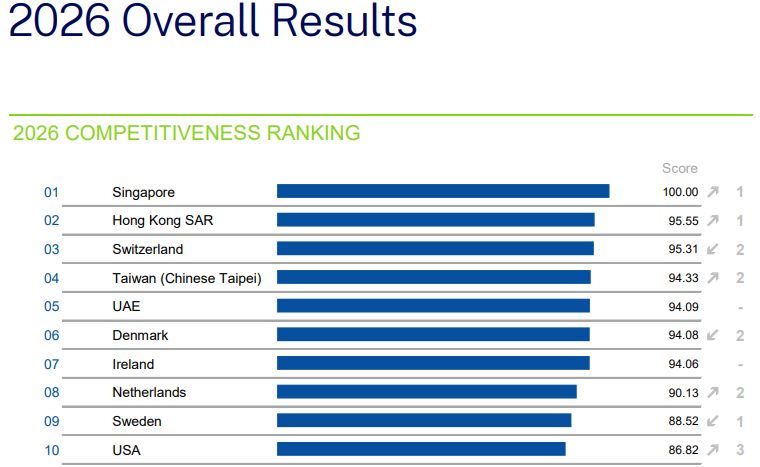
Hong Kong rose to second place globally in competitiveness, driven by its strong government efficiency and attractive fiscal policy. Despite excelling in basic infrastructure and finance, it faces pressures from a high cost of living, shrinking employment, and challenges in social equity.
The World’s Most Competitive Economies
Switzerland fell to third place due to a sharp decline in international investment, employment, and a high cost of living. However, it maintains its global leadership in government efficiency and infrastructure, supported by excellent education, healthcare, and investment in research.
Taiwan climbed to fourth place thanks to its strong economic growth, driven by technology exports and a robust scientific infrastructure. Despite its governmental stability, it faces challenges due to geopolitical tensions affecting foreign investment and its slow energy transition.
The UAE retained its fifth-place ranking globally thanks to its leadership in employment, foreign trade, and tax competitiveness. Despite the construction boom, aggregate productivity declined, female labor force participation remains low, and gaps persist in press freedom and scientific innovation.
Denmark fell to sixth place due to declines in economic performance, employment, and a high corporate tax burden. Despite this, it maintains a solid second-place ranking in infrastructure and business efficiency, standing out globally in health, education, and renewable energy.
European Countries
Ireland retained its seventh-place ranking. Its economy climbed to second place globally thanks to extraordinary growth in GDP, trade in services, and foreign investment. However, its infrastructure declined, and it faces persistent pressures from high living costs and rents.
The Netherlands rose to eighth place thanks to a rebound in trade, international investment, and advanced technological and logistical infrastructure. Despite regaining its government efficiency, it continues to face challenges from high housing costs, a heavy tax burden, and a slow energy transition.
Sweden fell to ninth place due to weaknesses in employment, youth unemployment, and a high tax burden. Nevertheless, it ranks fourth in infrastructure thanks to its leadership in environmental sustainability, social equity, education, and a strong scientific foundation.
U.S. Research and Development
The United States returned to tenth place, leading in finance and scientific infrastructure thanks to its massive investment in R&D. Despite the rebound in business confidence, it faces risks due to the fiscal deficit, protectionist trade policies, institutional deterioration, and social disparities.