

U.S. tantalum exports to Mexico grew at a year-over-year rate of 123% from January to April 2026, reaching $64.4 million.
Tantalum is a critical material for industries essential to the U.S. economy, such as electronics, aerospace, defense, medical devices, and energy.
Tantalum Exports
According to Global Advanced Metals (GAM), this material is used in the production of capacitors employed in electronic components across all high-demand industries. It is used in consumer electronics, medical devices, AI servers, and military systems. It is also used in aerospace components, missile systems, medical implants, and chemical processing tools.
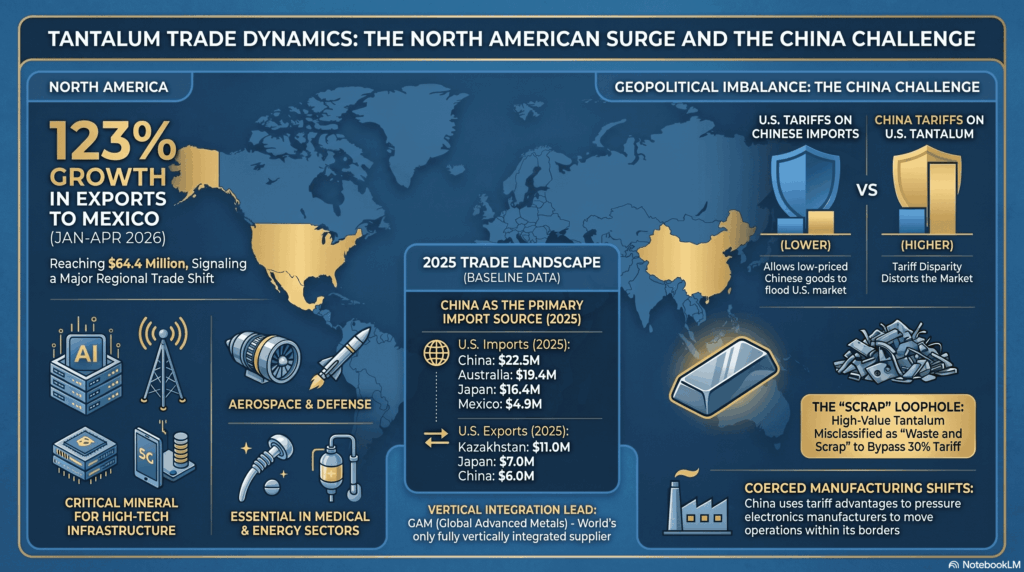
Based in Boyertown, Pennsylvania, GAM is a global leader in the critical metals industry, known for being the only fully vertically integrated supplier of tantalum.
The following table shows U.S. tantalum exports to Mexico, in millions of dollars:
- 2018: 101.
- 2019: 72.
- 2020: 69.
- 2021: 82.
- 2022: 82.
- 2023: 41.
- 2024: 60.
- 2025: 114.
These trade flows include tantalum ores and their concentrates, synthetic tantalum-niobium concentrates and raw materials, waste, scrap, and powder. They also include bars and rods obtained solely by sintering.
Minerals in Geopolitics
GAM informed the United States Trade Representative (USTR) that the current tariff structure on various tantalum products reveals a significant imbalance. It argued that Chinese tariffs on tantalum imports are higher than those in the United States. This disparity creates an environment in which Chinese suppliers can flood the U.S. market with tantalum products at unfairly low prices.
This severely harms U.S. manufacturers, who, in turn, are unable to maintain business operations in China.
According to GAM, China has used this advantage to manipulate electronics manufacturers, inducing them to operate within China to avoid tariffs, despite the oversupply of tantalum capacitors in particular and electronics production in general in China.
In addition to the Mexican market, the United States exported tantalum to other destinations in 2025, including Kazakhstan ($11 million), Japan ($7 million), and China ($6 million).
U.S. Tariffs
To restore fairness, GAM proposed to the USTR that U.S. tariffs should continue to rise until they match or exceed Chinese tariffs on U.S. imports. Current tariff rates give China an unjustified advantage, creating an environment in which U.S. manufacturers struggle to compete while Chinese producers dominate the market.
GAM argues that the Trump administration was correct to raise the import tariff on Chinese-made tantalum waste and scrap as part of the broad tariff increases in 2025, but prior to that, the tariff was 0 percent.
Pro added that Chinese suppliers are exploiting a legal loophole by misclassifying higher-value tantalum products as waste and scrap, allowing them to circumvent the higher tariffs.
This allows Chinese manufacturers to avoid the full 30% tariff on those high-value products, distorting the market and giving them a significant price advantage over U.S. producers.
In 2025, the United States imported tantalum primarily from China ($22.5 million). Other suppliers included Australia ($19.4 million) and Japan ($16.4 million). Mexico exported $4.9 million worth of tantalum to the U.S. market that year.