

Digital services exports in North America reach $160 billion annually, according to the Mexican Association of the IT Industry (AMITI).
In this region, cross-border exports of digital services have grown at an average annual rate of 12%. This growth outpaces the growth of trade in goods by a ratio of nearly three to one.
For AMITI, this trend demonstrates how digital trade has become one of the most dynamic drivers of regional competitiveness.
AMITI represents Mexico’s technology and digital industries. It has more than 200 member companies. All of them operate in the hardware, software, IT services, consulting, and digital solutions sectors. More than 92,000 professionals work at companies affiliated with this organization.
Exports of Digital Services
In an article published by the Center for Strategic and International Studies (CSIS), Diego Marroquín argues that data flows underpin manufacturing, financial services, logistics, and critical infrastructure in the three economies of the United States-Mexico-Canada Agreement (USMCA).
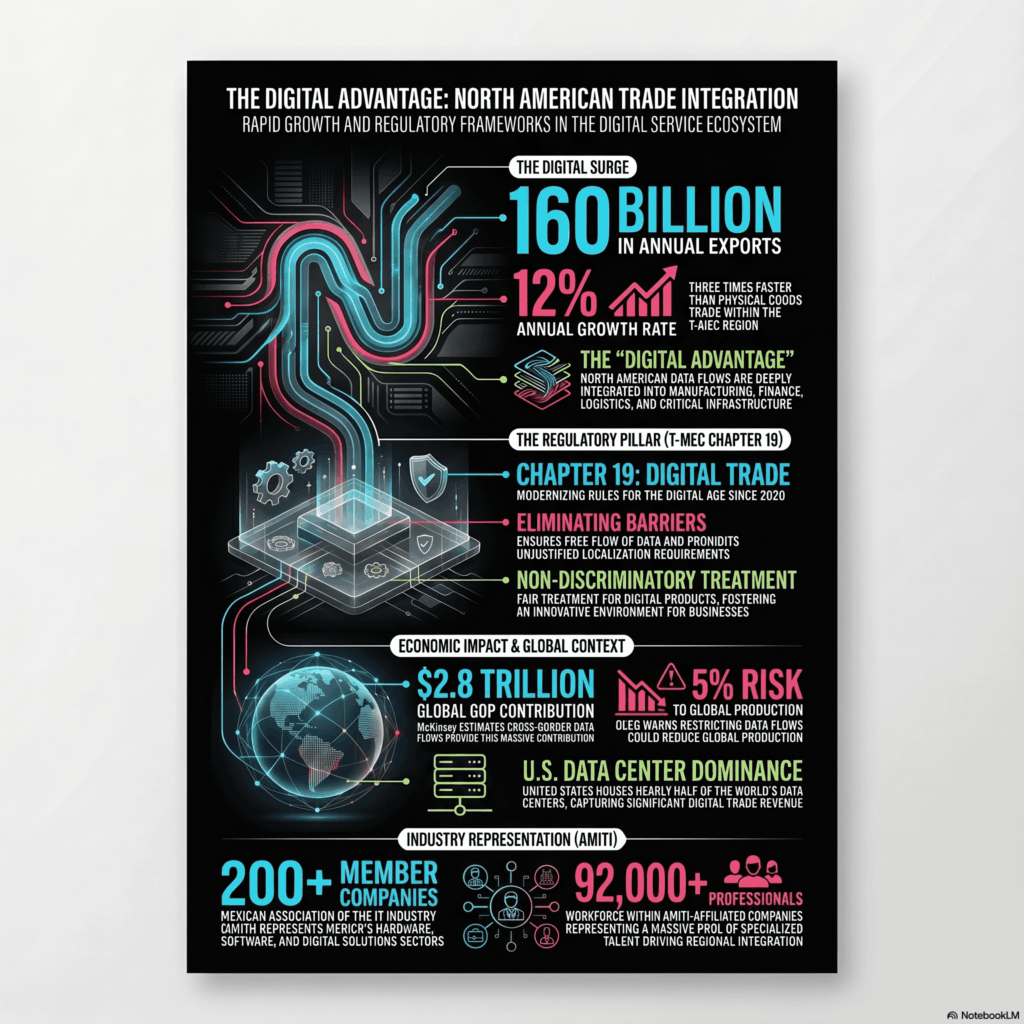
While other trade agreements include digital provisions, none operate within a production ecosystem as deeply integrated as North America’s. In this region, goods, services, and data cross borders multiple times before reaching the end consumer. According to Marroquín, these rules are put to the test daily through supply chains, transactions, and investment decisions. He concludes that this is North America’s digital advantage.
Regulations in the USMCA
Regarding digital services exports, Chapter 19 of the USMCA—Digital Trade—has become a cornerstone of North America’s competitiveness. For AMITI, modernizing this chapter is essential for the region’s shared digital future.
Since the USMCA entered into force in 2020, Chapter 19 on Digital Trade has driven integration. Its provisions are not theoretical. AMITI asserts that these regulations are generating measurable results. By ensuring the secure free flow of data, prohibiting unjustified data localization requirements, and ensuring non-discriminatory treatment of digital products, Chapter 19 has created a predictable and innovative environment. Importantly, it benefits businesses of all sizes.
U.S. Benefits
McKinsey estimates that cross-border data flows contribute $2.8 trillion to global GDP. For this reason, the OECD warns that restricting these flows could reduce global output by up to 5%. The United States accounts for a disproportionate share: it is home to nearly half of the world’s data centers, and the revenue generated by cross-border data transfers primarily benefits U.S. companies.