

China accounts for 99% of the global supply of refined gallium. This creates vulnerabilities in multiple strategic technology sectors, according to USA Rare Earth, Inc.
Gallium is obtained as a byproduct of aluminum refining (bauxite processing).
Globally, the world’s gallium production capacity exceeds 2,000 tons per year and is growing by approximately 15% annually.
Refined Gallium Supply
Gallium is a strategic input for the technology industry. Through gallium arsenide and gallium nitride, it powers advanced semiconductors, fast chargers, electric vehicles, and 5G infrastructure. Furthermore, it is essential in the manufacture of high-efficiency LEDs and photovoltaic solar panels.
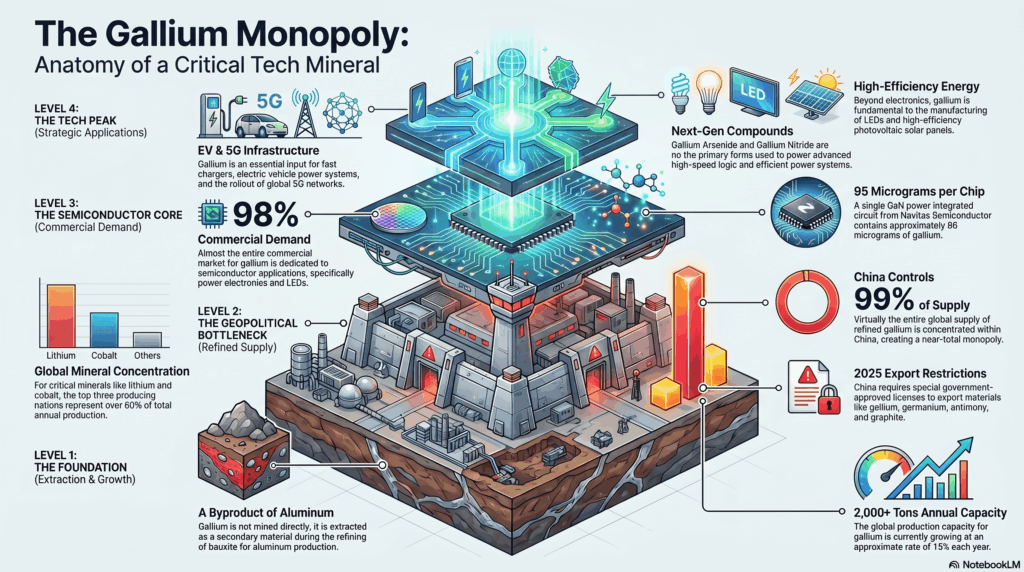
In addition to the fact that the supply of refined gallium is concentrated, China imposed and expanded controls and restrictions on the export of certain rare earths and related materials in 2025. As a result, companies are required to obtain special export licenses and approval from the Chinese government to export products containing even small amounts of rare earths of Chinese origin, among other restrictions.
Semiconductor applications, such as power electronics, LEDs, and high-speed logic, account for 98% of commercial demand for gallium. For example, each GaN power integrated circuit from Navitas Semiconductor Corporation contains approximately 95 micrograms of gallium.
More recently, the rise in demand for gallium semiconductors has been increasingly linked to the adoption of electric vehicles and the rollout of 5G wireless networks. Gallium is also used as an alloying element in neodymium-iron-boron magnets, as well as in research and development applications.
Critical Minerals
Governments have increasingly adopted aggressive approaches to trade in critical minerals. China has imposed bans or restrictions on the export of several critical minerals, including gallium, germanium, antimony, graphite, and seven categories of medium and heavy rare earths. These measures are directed at the United States.
Meanwhile, the United Kingdom and the United States have imposed restrictions on metal imports from Russia in response to the war in Ukraine. These actions and their subsequent effects have highlighted global dependence on a limited number of countries for key critical minerals.
This concentration of key critical mineral extraction is evident. In the case of lithium, cobalt, graphite, and rare earths, the top three producing nations account for more than four-fifths of annual global production.