

The Modernized Global Agreement (MGA) between Mexico and the European Union governs access to public procurement. This was one of the most contentious issues in the negotiations.
First and foremost, companies from Mexico and the European Union compete on equal terms without automatic advantages for local suppliers, allowing a Mexican company to bid on European contracts and vice versa.
Under the MGA, governments are required to publish complete information on their procurements, including expected prices, selection criteria, and deadlines. Additionally, this agreement establishes strict rules to exclude suppliers with convictions for fraud. Furthermore, specific rules against conflicts of interest are applied to ensure the proper use of public funds.
Modernized Global Agreement
The AGM will be signed this Friday in Mexico City. It will be the modernized version of the Free Trade Agreement between the European Union and Mexico (TLCUEM), in force since 2000.
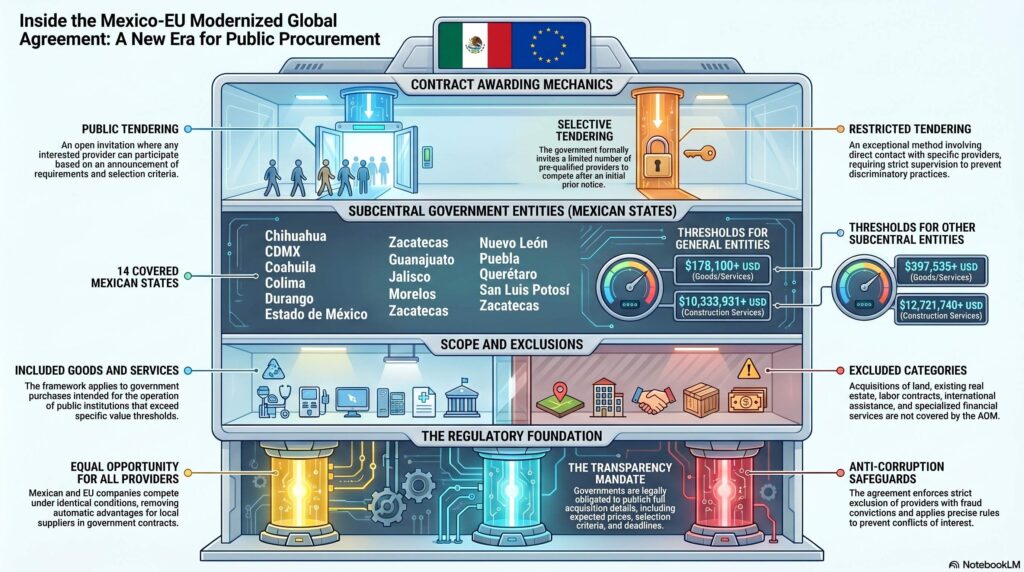
The provisions apply to government purchases of goods and services intended for the operation of public institutions above the value thresholds established for each country.
Excluded are land acquisitions, existing real estate, employment contracts, purchases intended for international assistance, and certain specialized financial services.
The minimum thresholds ensure operational flexibility for governments in their smaller-scale procurements.
Sub-central government entities
1.- Unless otherwise provided, Chapter 21 of the AGM (Public Procurement) applies to procuring entities in the states of Chihuahua, Mexico City, Colima, Durango, the State of Mexico, Guanajuato, Jalisco, Morelos, Nuevo León, Puebla, Querétaro, San Luis Potosí, Veracruz, and Zacatecas:
(a) With respect to the subcentral government entities listed in Sublist 1 (Government Entities) of each state, it applies if the value of the supplies is equal to or greater than the following thresholds:
- USD 178,100 for goods and services specified in Sections D and E.
- USD 10,333,931 for construction services specified in Section F; and (b) with respect to the other sub-central entities listed in the Sublist.
(b) (Other Entities) of each State, if the value of the supplies is equal to or greater than the following thresholds:
- USD 397,535 for goods and services specified in Sections D and E.
- USD 12,721,740 for construction services specified in Section F.
- The thresholds set forth in paragraph 1 apply in the year this Agreement enters into force. In addition, they are subject to adjustment for inflation in accordance with paragraph 14 of the Notes to this Section.
Awarding of Contracts
Contracting entities have three approaches for awarding contracts. The first is open tendering, which opens participation to any interested supplier through a notice setting forth the requirements and selection criteria. The second is selective tendering, where, following prior notice, the government formally invites a limited number of suppliers qualified under pre-established criteria to compete. Finally, restricted bidding allows for direct contact with specific suppliers. This option is exceptional in nature and requires strict oversight to prevent discriminatory practices.