
The Interim Trade Agreement (ITA) between Mexico and the European Union will allow Mexico to immediately eliminate or reduce tariffs. As a result, Mexico will be able to access the European Union market for products for which bilateral market access had been pending.
The European Union (EU) is a unique political and economic association based on the cooperation of sovereign nations. It emerged after World War II to foster interdependence and prevent future conflicts. Furthermore, the bloc has grown from six founding members to the current 27 member states.
Today, the EU is a pillar of stability and prosperity that encompasses much of Central and Eastern Europe.
Interim Trade Agreement
Mexican President Claudia Sheinbaum and European Commission President Ursula von der Leyen will sign the Modernized Comprehensive Agreement on May 22. This agreement is subject to ratification by the European Parliament, the legislatures of the 27 member countries, and the Mexican Senate.
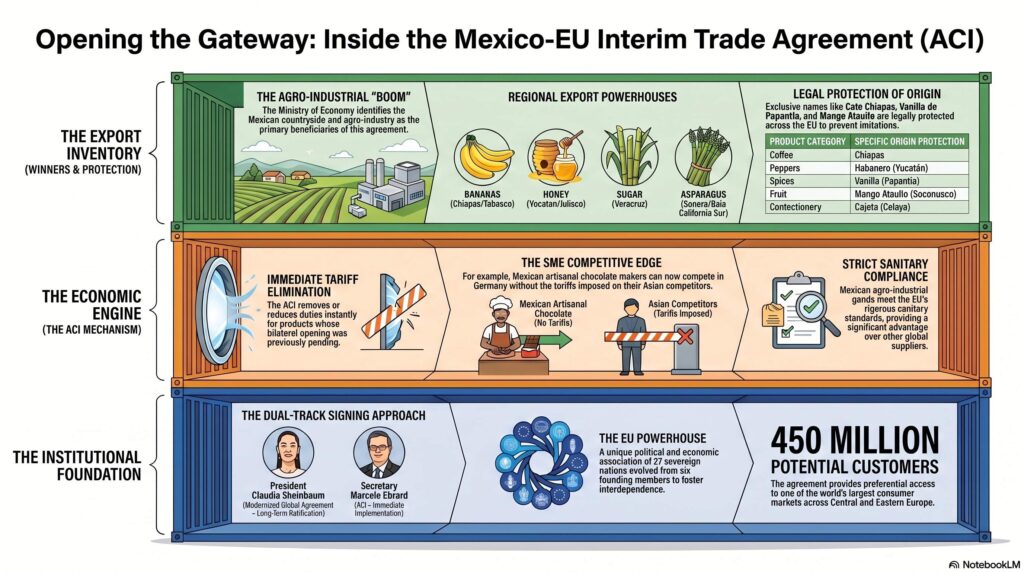
Meanwhile, Economy Secretary Marcelo Ebrard will sign the Interim Trade Agreement (ITA) with European Commissioner for Trade Maros Sefcovic. This agreement will enter into force immediately.
“The signing of the Interim Trade Agreement is great news for Mexico. It will allow Mexican companies and farmers—from large corporations to small and medium-sized enterprises—to gain preferential access, with virtually no tariffs, to a market of 450 million people across the 27 countries that make up the European Union,” the Ministry of Economy said in a press release.
For example, a Mexican artisanal chocolate SME can compete in Germany without paying the tariffs that its Asian competitors do pay.
The Mexican agricultural and agro-industrial sectors are the big winners of the ITA, according to the Ministry of Economy. Furthermore, the ministry added, this agreement will generate “a boom in Mexican agricultural exports.”
Business Opportunities
Various Mexican agri-food products—including bananas from Chiapas, Tabasco, and Oaxaca; honey from Yucatán and Jalisco; sugar and piloncillo from Veracruz; as well as asparagus from Sonora and Baja California Sur—will gain access to the European market with preferential or zero tariffs. Furthermore, these goods meet the strictest health standards, giving them a competitive advantage over other global suppliers.
In addition, products with a Designation of Origin, such as Chiapas Coffee, Yucatán Habanero Chili, Papantla Vanilla, Soconusco Ataulfo Mango, and Celaya Cajeta, will enjoy legal protection throughout the European Union, ensuring the exclusivity of their names against potential imitations.