
To counter the advance of the New World Borer, the U.S. Department of Agriculture (USDA) is funding the doubling of sterile fly production in Mexico in 2026.
According to the Northeast Organic Dairy Producers Alliance (NODPA) in the United States, the USDA has responded to this problem by completing the construction of a facility for the release of sterile flies in Edinburgh, Texas.
At the same time, the USDA has funded the expansion of the Metapa facility in Mexico to double sterile fly production by 2026.
Advance of the New World Screwworm
The resurgence of the screwworm poses a critical risk to the Mexican livestock industry. Its larvae parasitize live animals, causing devastating infestations that damage tissue and lead to death. With more than 14,000 reported cases, the northward advance in Mexico seriously threatens exports and economic stability.
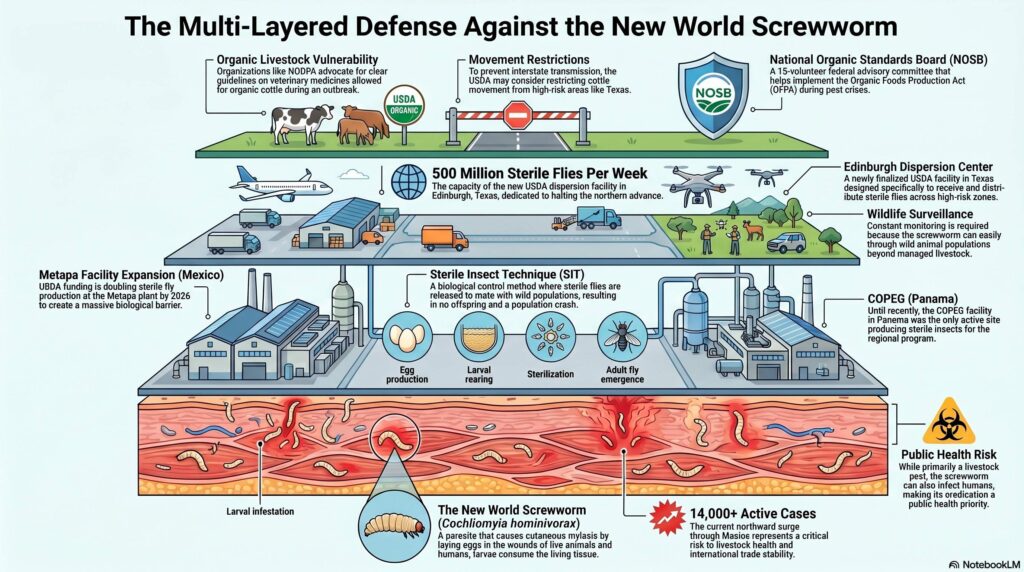
With the New World screwworm advancing through northern Mexico toward Texas, the NODPA warned the National Organic Standards Board (NOSB) that the ongoing prevention and control of this pest will remain a significant challenge for organic livestock producers.
Previously, this worm was controlled through a USDA sterile insect release program, with multiple facilities in the United States, Mexico, and Panama. These facilities produced and released sterile flies. Unfortunately, all facilities except COPEG in Panama stopped producing sterile insects several years ago.
The NOSB is a federal advisory committee in the United States. It is composed of 15 volunteers from the organic community. Its primary function is to advise the Secretary of Agriculture on the implementation of the Organic Food Production Act (OFPA).
Dairy Cows
The USDA has begun construction of a new facility in Texas with a production capacity of 500 million sterile flies per week. However, the release of sterile insects takes time to reduce populations. Furthermore, since Texas is home to some of the largest herds of organic dairy cows, the NODPA argued that the USDA should consider restricting the movement of livestock from Texas. This would help prevent the spread of the borers to other states.
From their perspective, certifiers must also take into account that infected cattle will require treatment, and producers will seek advice from their certifiers on what steps they can take.
The USDA is approving many new medications to prevent the spread of the borers. However, the NODPA has warned that there are no guidelines from either the certifiers or the National Organic Program (NOP). There is no clear guidance on which medications organic livestock operations should use.
Health risk
NODPA has asked the NOP to collaborate with certifiers and the NOSB. It has requested that they provide as much clarity and consistency as possible in regulating the veterinary products that organic livestock producers may use.
This is a clear example of how public investment in sterile facilities for insect control generates a significant return on investment in preventing problems with the borers. Furthermore, surveillance and understanding of how this insect can spread through livestock and, especially, wildlife, are essential to preventing new outbreaks.
The NODPA is the largest organic dairy producers’ organization in the United States, with 820 affiliated organic dairy producers in the eastern United States.
The New World screwworm poses a public health risk. Although the New World screwworm (Cochliomyia hominivorax) primarily affects livestock, it can also cause cutaneous myiasis in humans.