
A panel of the Court of International Trade (CIT) ruled on Wednesday against the Section 122 tariffs imposed by U.S. President Donald Trump, although it did not authorize a stay of these tariffs, which are applied at a rate of 10% to most countries.
This ruling comes after the Supreme Court struck down Trump’s global tariffs under the International Emergency Economic Powers Act (IEEPA) last February.
Section 122 Tariffs
Previously, as part of its reasoning for ruling that the IEEPA did not authorize global tariffs in response to a trade deficit, the CIT argued that “tariffs in response to a trade deficit fall under Section 122.”
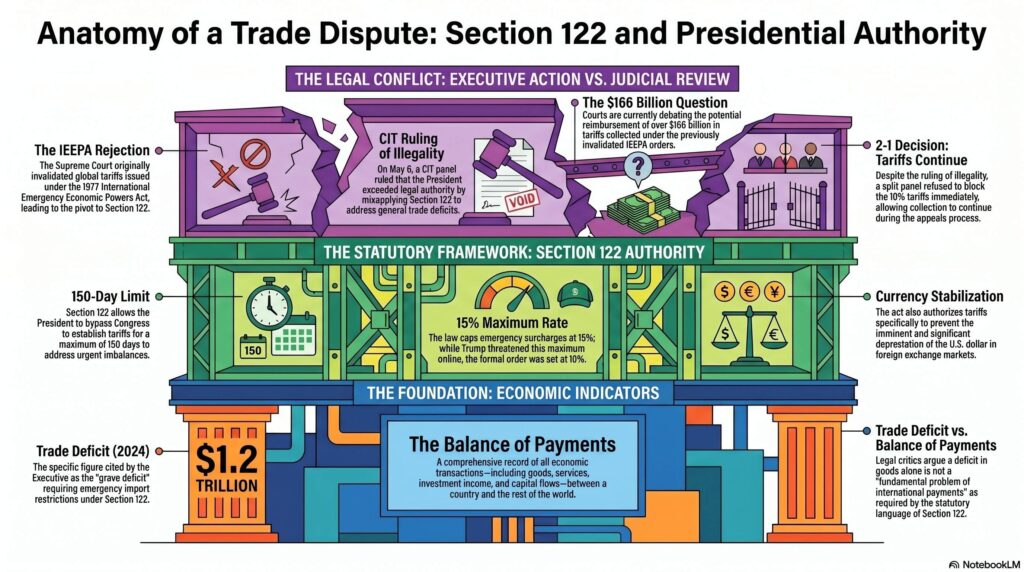
The court noted that “trade deficits are one of the main balance of payments deficits.” When the U.S. government appealed the CIT’s decision to the U.S. Court of Appeals for the Federal Circuit, it argued that Section 122 “has no obvious application in this case, as the concerns identified by the President… arise from trade deficits, which are conceptually distinct from balance of payments deficits.”
The U.S. Court of Appeals for the Federal Circuit upheld the CIT’s decision without addressing the application of Section 122 to trade deficits, a decision that was in turn affirmed by the Supreme Court.
A dissenting opinion from the U.S. Court of Appeals for the Federal Circuit held that “a trade deficit in goods alone is not sufficient for the application of Section 122” and that trade deficits do not constitute a “fundamental problem of international payments” under that section.
Trade Deficit
Under Section 122, the Executive Branch has the authority to impose tariffs of up to 15% for a maximum period of 150 days without requiring congressional approval.
Originally, the Trump administration’s first round of global tariffs was based on the IEEPA; however, the Supreme Court ruled that the 1977 legislation did not authorize such measures. Faced with this legal setback, and just hours after the ruling, Trump signed a new order to impose a 10% tariff invoking Section 122.
The official justification for this measure was the U.S. goods trade deficit, which reached $1.2 trillion in 2024. Although the president later threatened on social media to raise the tariff to 15%, the proposal was never formally enacted.