

Computer exports from Mexico to China grew at a year-over-year rate of 561% in 2025, reaching $2.313 billion.
Over the previous seven years, these flows fluctuated between $125 million and $350 million, according to data from China’s General Administration of Customs.
Computer Exports from Mexico to China
Global demand for these machines has accelerated, driven by the end of support for Windows 10 in October 2025, forcing companies to undertake a massive fleet upgrade to Windows 11. This corporate upgrade cycle aims to mitigate security vulnerabilities and ensure long-term operational compatibility.
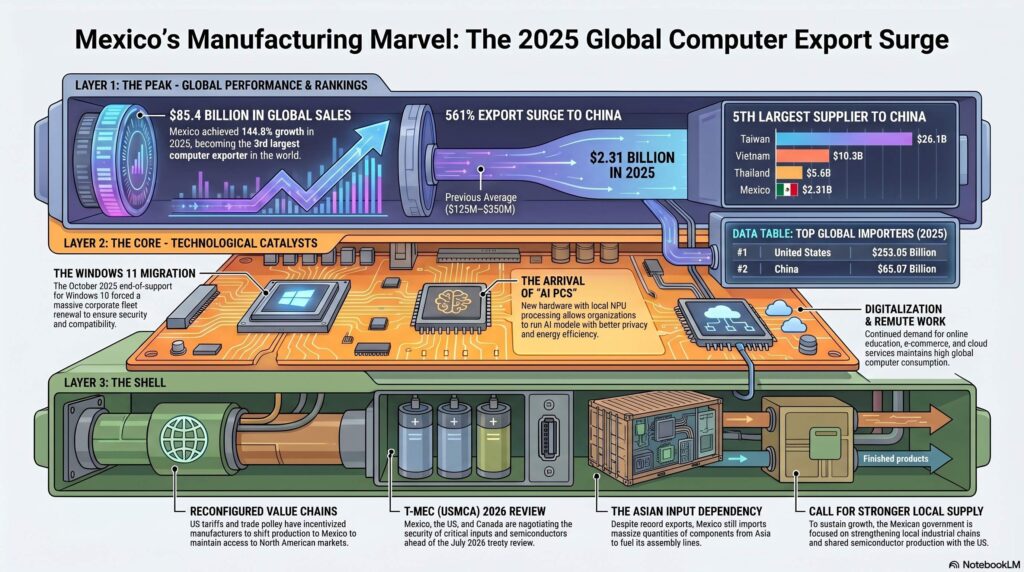
Simultaneously, the emergence of “AI PCs” with on-device processing (NPU) has redefined the value of hardware. According to Gartner and Canalys, the adoption of these devices aims to “prepare for the future” of organizations, enabling the execution of language models and AI tasks with greater privacy, speed, and energy efficiency.
With this export surge, Mexico ranked as the fifth-largest external supplier of computers to the Chinese market, trailing Taiwan ($26.166 billion), Vietnam ($10.334 billion), Thailand ($5.605 billion), and Malaysia ($4.973 billion).
Mexican Manufacturing
Mexico climbed from fifth to third place among the world’s largest computer exporters in 2025. Its growth rate was the highest among the leaders in the ranking, rising 144.8% to reach $85.416 billion in exports.
Demand for computers has increased in the world’s major markets. Key drivers of purchases include accelerated digitization, online education, and remote work. Additionally, the rise of artificial intelligence, e-commerce, and cloud services is influencing the trend.
In 2025, China ranked as the second-largest importer of computers globally, with purchases totaling $65.073 billion. The United States ranked first, with $253.056 billion.
Mexico needs to strengthen its supply chain, given that it imports large quantities of inputs from Asian countries.
The growth in Mexican computer exports is partly explained by the tariffs imposed by U.S. customs and the reconfiguration of value chains.
The governments of Mexico and the United States have expressed their intention to increase joint production related to semiconductors. Both nations, along with Canada, are negotiating the revision of the United States-Mexico-Canada Agreement (USMCA), scheduled for July 1, 2026. Discussions have included securing critical or strategic inputs