
The German Chamber of Industry and Commerce (DIHK) noted that industrial capacity in Germany has been declining and issued a statement in defense of the ongoing USTR Section 301 investigation.
According to the DIHK, industrial capacity in Germany and Europe has declined in many sectors in response to changing market dynamics and global competition.
Industrial capacity in Germany
Capacity utilization among European and German industrial companies is below average, at just 77% in January 2026.
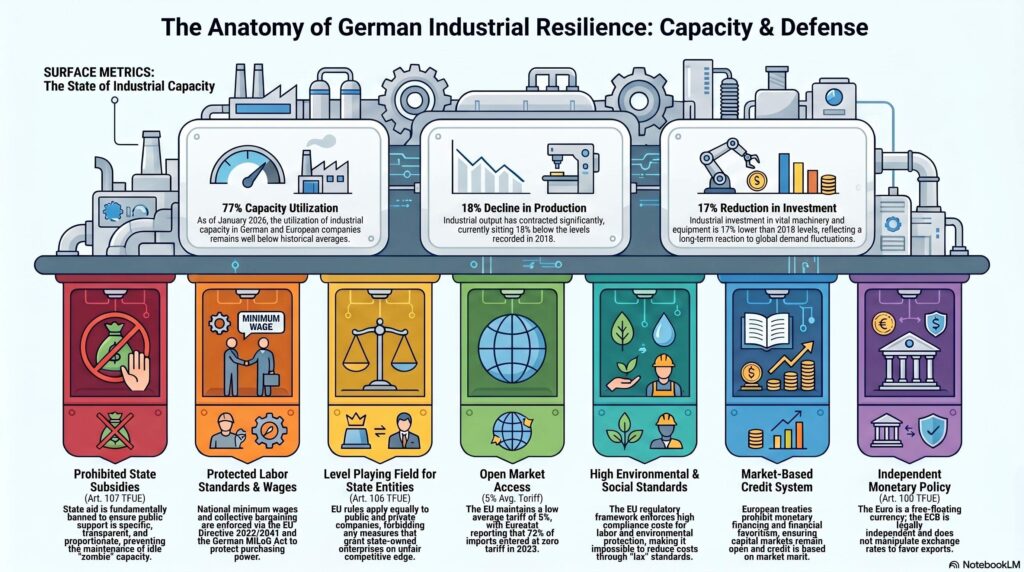
At the same time, German industry has been reacting to fluctuations in global demand for years and has consequently reduced its production capacity: industrial output is now 18% below 2018 levels. Furthermore, industrial investment in machinery and equipment is 17% below 2018 levels.
The DIHK’s comments were issued in response to the Section 301 investigation regarding structural overcapacity and production in certain manufacturing sectors.
Section 301
According to the DIHK, German companies do not unfairly benefit from any of the following measures implemented by Germany and the European Union, as no jurisdiction
Subsidies and the Market
Promoting production or exports outside of market forces through subsidies, as state aid is allegedly prohibited under Article 107 of the TFEU. This system ensures that any public support remains targeted, proportionate, and transparent, while avoiding the maintenance of idle capacity.
Wages and Regulations
Restrict national minimum wages, as established by Directive (EU) 2022/2041, which strengthens collective bargaining and purchasing power. In Germany, the MiLoG Act and its tripartite commission ensure wage adequacy for all companies operating in the European Union.
Competition among firms
Rely on non-commercial activities of state-owned enterprises, as European Union rules apply equally to public and private entities. Article 106 of the TFEU requires Member States not to maintain measures contrary to free competition regarding enterprises with special rights.
Market Access
Maintaining sustained market access barriers. The European Union’s tariff regime is low and predictable, averaging 5%. Eurostat notes that 72% of imports entered at zero tariffs in 2023, demonstrating an openness that benefits all companies.
Protection Standards
Lowering labor, environmental, or social standards to cut costs. The European Union’s framework sets high standards for its companies, so its structure cannot be characterized as a cost-cutting measure achieved through lax protections.
Credit system
Providing subsidized loans or engaging in financial repression, given that the European Union protects open capital markets. The European Treaties prohibit monetary financing and financial favoritism, upholding a market-based credit system.
Exchange rate practices
Manipulating exchange rate practices, as the euro is a freely floating currency. The ECB is independent under Article 130 of the TFEU and does not set exchange rates as a target, ensuring neutrality in the foreign exchange market.