
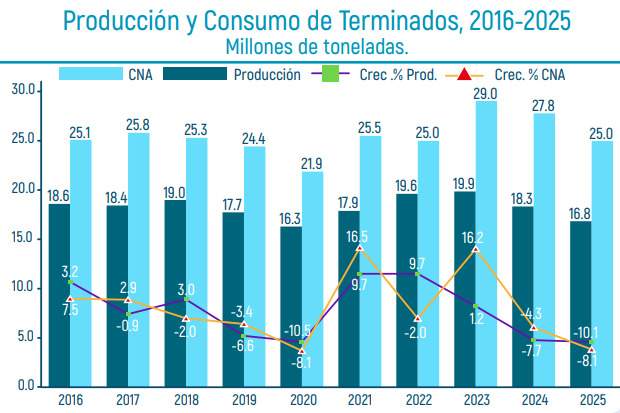
The National Chamber of the Iron and Steel Industry (Canacero) proposed to the USTR that it impose sanctions on steel transshipment in coordination with Mexico.
In addition, the Chamber suggested that the U.S. government establish a North American Steel Coordination Mechanism.
Steel Transshipment
Canacero proposed to the USTR the joint application of Section 301 against transshipment by non-market economies.
To the extent that the USTR’s concerns regarding Mexico relate specifically to Chinese steel transshipped through Mexican territory, the Chamber recommended establishing a formal joint enforcement protocol with the USTR and CBP. This protocol would help to identify, investigate, and sanction such transshipment.
In Canacero’s view, Mexico has both the interest and the institutional capacity to effectively enforce anti-transshipment rules. Moreover, Mexico is willing to make a formal commitment to do so.
Mexico is a net importer of steel, with domestic steel production capacity below the country’s apparent steel consumption. Therefore, this prevents Mexico from being considered a source of structural excess capacity
Coordination Mechanism
In a letter addressed to the United States Trade Representative (USTR), Canacero suggested that the North American Steel Coordination Mechanism be established within the United States-Mexico-Canada Agreement (USMCA).
She specified that the mechanism would allow for joint monitoring of steel trade flows. Additionally, it would establish coordinated enforcement of anti-circumvention laws and the harmonization of positions in multilateral forums such as the Global Forum on Steel Excess Capacity (GFSEC).
“This is the appropriate, treaty-based framework for addressing shared concerns, and Mexico is willing to participate in it,” said Canacero.
As part of this initiative, the mechanism would operate through a permanent bilateral or trilateral working group to coordinate the monitoring of steel trade, share real-time data on import flows, and “harmonize enforcement measures against circumvention and transshipment.”
In addition, this mechanism would provide an institutional framework consistent with the USMCA to address common concerns without resorting to unilateral measures.