
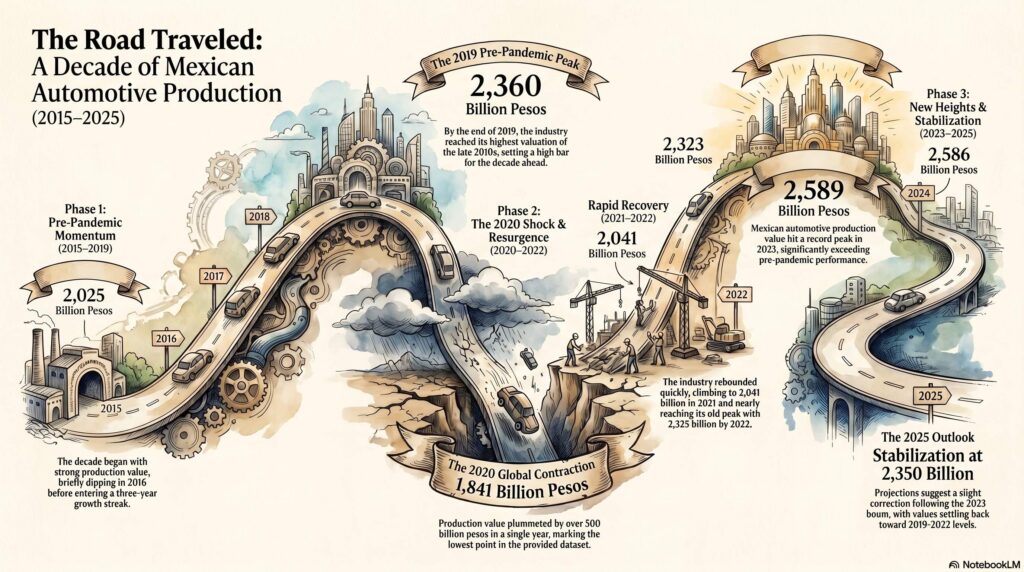
Automobile and truck production in Mexico declined in real terms in 2025, following a trend of ups and downs over the past decade.
In 2025, Mexican manufacturing of both types of vehicles fell at a year-over-year rate of 9.1%, according to data from INEGI.
Automobile and truck production in Mexico
General Motors leads the automotive industry in Mexico, followed by Nissan and Stellantis. In heavy-duty vehicles, Freightliner, Kenworth, and International lead the way. Along with Volkswagen, Ford, and Toyota, these companies dominate manufacturing and exports. Thus, they consolidate the country’s position as a global automotive hub.
At 2018 prices, Mexican car and truck manufacturing totaled 2.35 trillion pesos in 2025. This represents a cumulative increase of just 16% in real terms.
Mexico offers competitive advantages due to its access to the USMCA, a skilled workforce, and mature clusters. However, companies face critical challenges such as U.S. President Donald Trump’s tariff policy. Additionally, they must navigate the transition to electromobility, logistical congestion at ports, and uncertainty regarding local energy policies.
Shared Production
Some economists credit NAFTA/USMCA with boosting the competitiveness of U.S. manufacturing industries. The automotive sector, in particular, has grown stronger through the development of North American supply chains.
An analysis by the U.S. Congress indicates that a significant portion of merchandise trade between the United States and Mexico takes place within the context of shared production. This is because manufacturers in both countries collaborate to create goods.
The flow of intermediate inputs produced in the United States and exported to Mexico, as well as the return of finished products, significantly increased manufacturing activity. This effect is primarily observed in the U.S.-Mexico border region.
U.S. industries, including the automotive and electronics sectors, rely on inputs from Mexican manufacturers. In the automotive sector, for example, there are complex connections between U.S. and Mexican suppliers and assembly centers.
The analysis adds that a car produced in the United States, for example, may contain thousands of parts sourced from different U.S. states and various Mexican locations. The final assembly location may have little connection to the origin of its components.