
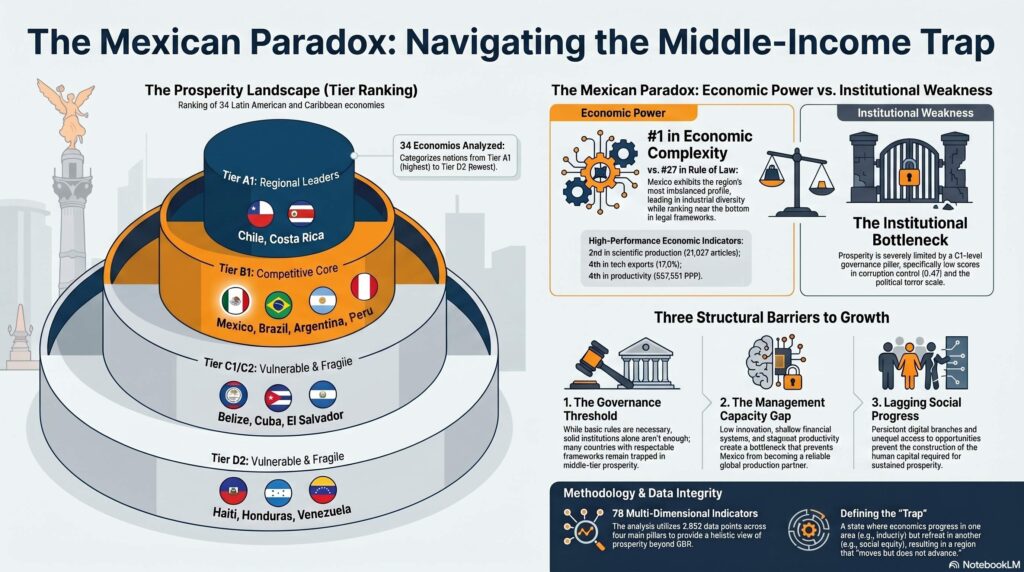
Prosperity in Mexico has been hindered by the middle-income trap, as reflected in a recent IMD ranking of 34 economies in Latin America and the Caribbean.
The ranking is divided into four pillars: Economic Challenges, Governance and Institutions, Management Dynamics, and Social Empowerment. It uses 78 indicators for this purpose. Countries are classified into eight levels, from A1 (highest) to D2 (lowest).
Prosperity in Mexico
As global supply chains are reconfigured due to geopolitical tensions and U.S. tariffs, Latin America could benefit from new industrial opportunities. However, without greater business management capacity, the region risks missing this window of opportunity.
“If China ends up shifting production chains to Latin America to mitigate the impact of U.S. tariffs, the industrial opportunities will be real and significant. But without the right conditions, the region risks completely missing out on this moment,” notes José Caballero, lead author of the report and chief economist at the IMD World Competitiveness Center.
The middle-income trap
According to Caballero, the most troubling finding in the report has nothing to do with the countries that are struggling. It has to do with those that are doing more or less well and have been that way for years. Most of the region’s economies are neither in crisis nor booming. They are settled at an intermediate level of prosperity that seems less and less temporary and more and more permanent.
“Economies make progress in one area and regress in another. They reform one thing and neglect the next. The result is a region that moves, but does not advance,” says Caballero.
Three structural patterns explain why, from Caballero’s perspective.
First, governance matters, but only to a certain extent. Countries with strong institutions clearly outperform those without them. But once a basic threshold is crossed, governance ceases to be the differentiating factor. Several countries with relatively respectable institutional frameworks remain stuck at mid-levels of prosperity. The rules of the game are necessary. They are not sufficient.
Second, and this is the most relevant point given the current situation, managerial capacity is the bottleneck that no one wants to mention. While the world looks to Latin America for a reliable production partner, what it often finds are shallow financial systems, low innovation, limited entrepreneurial dynamism, and stagnant productivity. The managerial capacity required by the current opportunity is not built in response to a specific situation. And the data suggests that, across much of the region, there is still a long way to go.
Third, social progress continues to lag behind. Socioeconomic inequality, digital divides, and unequal access to opportunities persist even among the best-positioned countries. A region that fails to distribute the fruits of its growth cannot build the human capital that sustained prosperity requires.