

UNCTAD released an analysis of global trade in goods and services, featuring estimated data through the end of 2025 and projections for 2026.
These trade flows drive economic growth, improve productivity, and facilitate integration into global value chains, promoting investment, employment, and technology transfer among economies.
Analysis of Global Trade
Trade in goods rose from $19.5 trillion in 2018 to $24.5 trillion in 2024.
The main products traded globally include hydrocarbons, vehicles, machinery, electronic equipment, chemicals, metals, food, and manufactured goods. These sectors account for a large share of international trade, driven by industrial, energy, and consumer demand in developed and emerging economies.
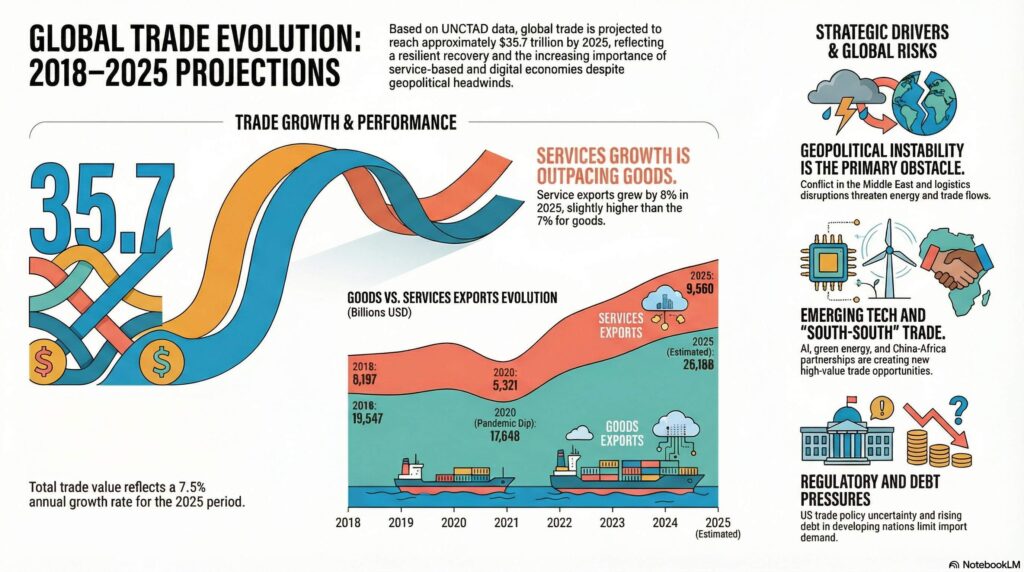
At the same time, trade in services increased from $6.2 trillion in 2018 to $8.9 trillion in 2024.
However, UNCTAD estimates that global trade grew by 7.5% in 2025, reaching approximately $35 trillion: trade in goods rose by 7%, and trade in services increased by 8%.
Outlook for Trade Flows
The conflict in the Middle East and disruptions in the Strait of Hormuz are affecting energy flows, logistics, and geopolitical stability, posing the main obstacle to global trade. Furthermore, according to UNCTAD, these developments have direct impacts on energy markets and indirect effects on global economic activity.
Uncertainty regarding U.S. trade policy persists despite tariff adjustments. Investigations under Section 301 and the upcoming review of the USMCA increase risks. At the same time, geo-economic competition is driving restrictive measures that fragment markets and raise regulatory costs.
Industrial policies, coupled with lower global demand, increase the risk of overcapacity in strategic sectors. Added to this are the slowdown in trade in services and higher logistics costs. Furthermore, rising debt in developing economies limits investment and import demand.
Positive Factors
Growth in the digital, artificial intelligence, and environmental technology sectors is driving global trade through high-value goods such as semiconductors and clean energy. Additionally, hub economies are emerging that attract investment and the relocation of production, strengthening international supply chains.
South-South trade is gaining momentum and diversifying markets, while emerging economies maintain resilient demand. Regional initiatives and preferential schemes are expanding market access, notably China’s measures toward Africa and potential renewals of agreements, creating additional opportunities for global trade.