
Auto parts production in Mexico has continued to rise year over year, with the exception of two years: 2020 and 2025.
On the one hand, in 2020, the COVID-19 pandemic affected production, consumption, and supply chains.
On the other hand, U.S. President Donald Trump’s tariff policy impacted consumption and created uncertainty in the automotive industry.
Trends in Auto Parts Production in Mexico
With strong interdependence with the United States, the Mexican auto parts industry maintains high competitiveness in the global automotive sector. Mexican companies such as Katcon, Metalsa, Vitro, Rassini, Sisamex, KUO, and Nemak contribute to this achievement. So do foreign companies such as Bosch, Continental, Denso, ZF Friedrichshafen, Autoliv, Magna International, and Valeo.
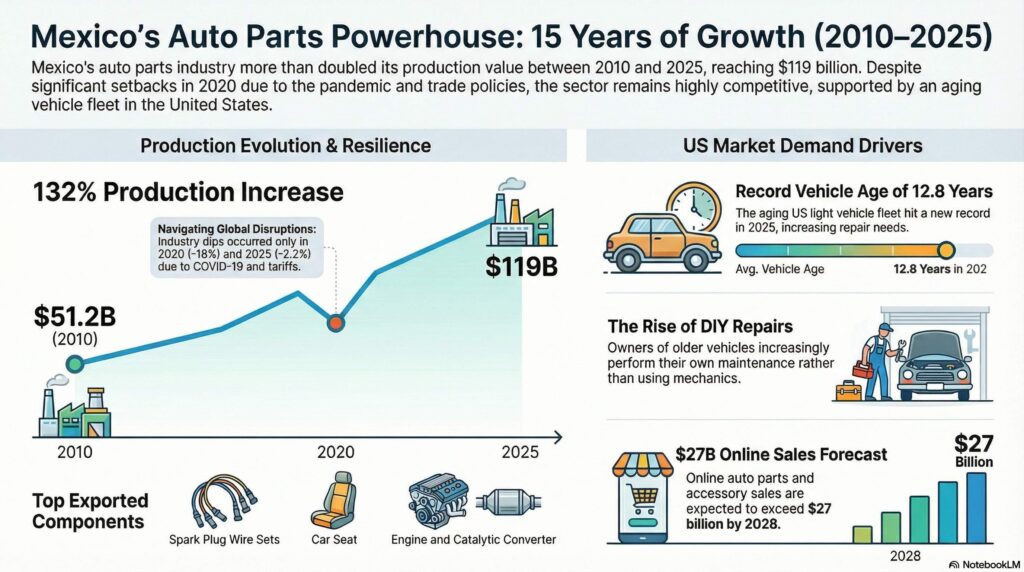
In 2020, Mexican automotive parts production fell by 18.0% year-over-year, to $78.884 billion. By 2025, this figure had declined by 2.2%, reaching $119.002 billion, according to data from the National Auto Parts Industry (INA).
Overall, this industry more than doubled its production, rising from $51.269 billion in 2010 to $119.002 billion in 2025.
Among the most exported auto parts are spark plug wire harnesses, body parts, seats, internal combustion engines, and catalytic converters.
U.S. Market
The average age of light-duty vehicles in the United States—an indicator of demand for auto parts—reached a new record of 12.8 years in 2025, according to the Automotive Care Association.
CarParts.com, Inc. believes that the growing vehicle fleet and the increase in the average age of vehicles will have a positive impact on overall demand for auto parts, as older vehicles generally require more repairs.
In many cases, the company believes that these older vehicles are driven by owners who perform their own repairs. They tend to handle necessary repairs themselves rather than taking their car to a repair shop.
For its part, the Automotive Care Association of the United States estimated that total revenue from online sales of auto parts and accessories would exceed $27 billion by 2028. Greater product availability, lower prices, and consumers’ growing familiarity with digital platforms are driving the shift to online sales.
The following shows the trend in auto parts production in Mexico (in millions of dollars):
- 2010: 51,269.
- 2011: 59,796.
- 2012: 77,564.
- 2013: 81,913.
- 2014: 86,791.
- 2015: 87,861.
- 2016: 89,607.
- 2017: 90,978.
- 2018: 97,133.
- 2019: 97,228.
- 2020: 78,884.
- 2021: 94,778.
- 2022: 106,665.
- 2023: 121,158.
- 2024: 121,693.
- 2025: 119,002.