
Corn consumption in Mexico hit a record high in the marketing year ending in September 2025, according to data from the U.S. Department of Agriculture (USDA).
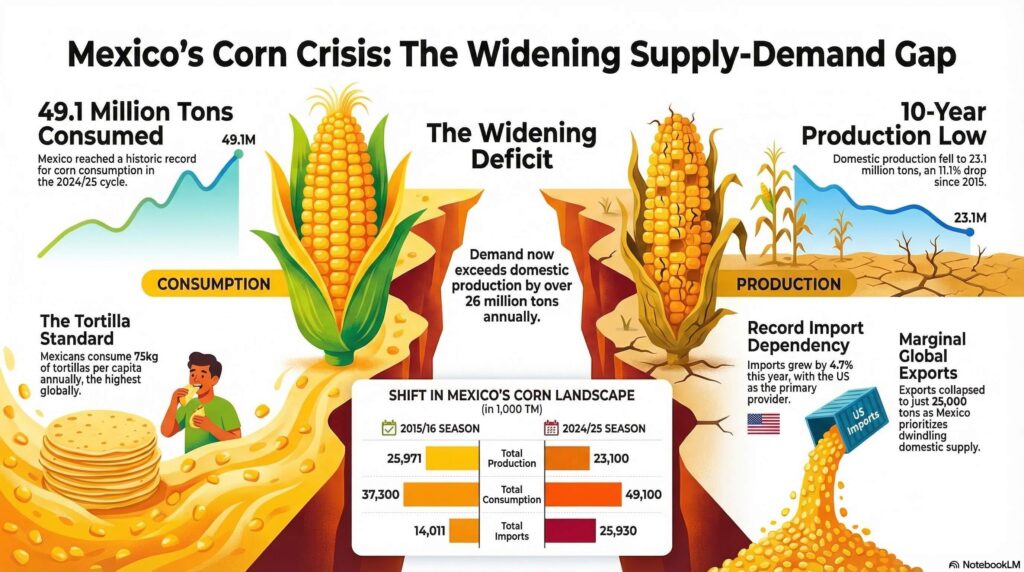
That year, Mexican consumption reached 49.1 million tons, a 31.6% increase over the 2015–2016 agricultural cycle.
Corn consumption in Mexico continues to rise, driven by the livestock and food sectors. However, demand exceeds domestic production, increasing reliance on imports, particularly from the United States. Corn is a strategic crop with economic, political, and cultural significance in Mexico.
Corn Consumption in Mexico
In contrast, Mexican corn production in the 2025 marketing year reached its lowest level in at least the last decade, falling to 23.1 million tons—11.1% less than in the 2015–2016 season.
In December 2025, the Mexican government expanded agricultural support programs, including guaranteed prices for small-scale corn producers (up to 5 hectares), at 7,000 pesos per ton. It also offers insurance, free fertilizers, and production incentives. However, its impact on total production will be limited.
In particular, the Fair Trade program offers free crop insurance to corn producers with planted areas of up to 50 hectares and a maximum production volume of 250 tons.
Mexico is the world’s sixth-largest producer of corn, a crop that accounts for 19% of the value of its national agricultural production. It is the most important staple food in the Mexican diet, with an annual per capita consumption of 75 kg of tortillas, making the country the world’s leading consumer.
Imports
In 2024/25, Mexican corn imports totaled 25,930,000 tons, an annual increase of 4.7%. This record figure is due to domestic production being reduced by exceptional drought and robust demand from the livestock and starch sectors, consolidating the United States as the almost exclusive supplier.
Conversely, Mexican corn exports amounted to 25,000 tons, a marginal figure in the global market. This low share, with minimal variation, is due to the priority given to domestic supply in the face of internal shortages and the limited competitiveness of white corn compared to imported grain.
The corn sector in Mexico is characterized by diversified production between large-scale commercial farming and subsistence agriculture. It faces structural challenges such as low productivity, high dependence on yellow corn imports for feed, and climate vulnerability due to recurring droughts.