

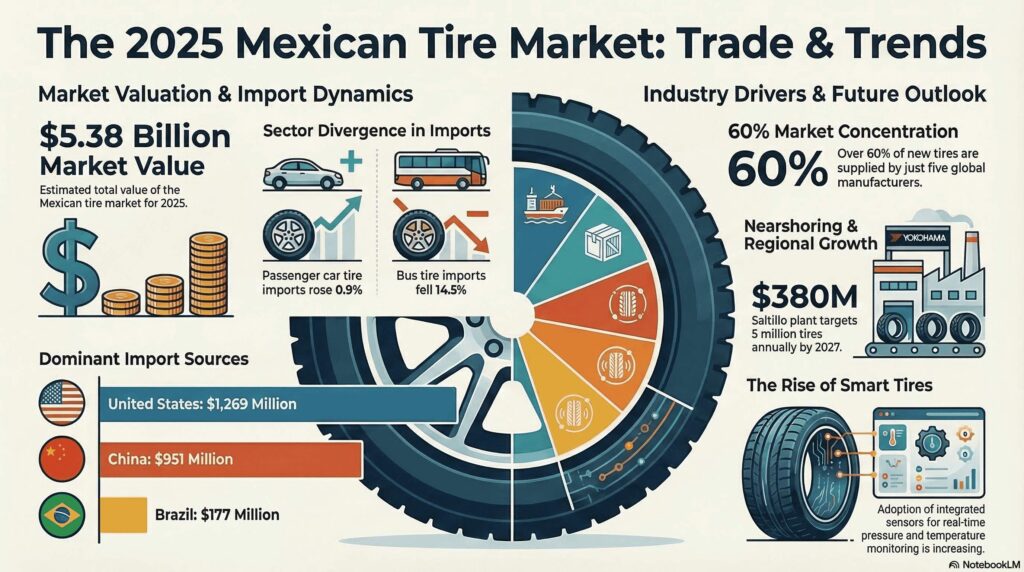
The Mexican tire market was valued at $5.38 billion in 2025, according to estimates by Mordor Intelligence.
In Mexico, there is strong demand for tires driven by automotive production and the vehicle fleet.
In 2025, Mexican tire imports totaled $3.866 billion, a 7.2% decline from 2024, according to data from INEGI.
Mexican Tire Market
The average passenger car tire lasts between 40,000 and 80,000 kilometers before needing replacement, depending on usage, maintenance, and tire type, making its durability a key factor in safety and costs for drivers.
Among the factors driving tire production in the country are vehicle manufacturing in North America, the shift toward SUVs and light trucks, and the tariff Mexico imposed on tire imports from Asia.
The tire sales system in Mexico is characterized by concentrated distribution chains, large distributors and dealers, high dependence on imports, and aggressive price competition. Note: More than 60% of new tires come from just five international manufacturers.
Tire Imports
Of the total tires imported into Mexico in 2025, those for passenger cars had a customs value of $1.708 billion, representing a 0.9% increase over 2024. Meanwhile, foreign purchases of bus tires totaled $1.546 billion, a 14.5% year-over-year decline, according to data from INEGI.
Mexico imports a large portion of its tires due to limited domestic production capacity, economies of scale offered by international manufacturers, competitive costs, growing demand from the automotive market, and the need to quickly supply dealerships and specialized repair shops.
In 2025, China ranked as the world’s largest tire exporter, with $22.514 billion, followed by Thailand ($7.593 billion), Germany ($5.725 billion), Japan ($5.293 billion), and the United States ($4.576 billion).
Globally, China leads tire production because it is the largest producer of light vehicles and due to its competitive manufacturing capacity, technological investment, economies of scale, and export policies.
Even so, the United States was the top exporter of tires to the Mexican market in 2025, with $1.269 billion, with Mexico being its second-largest export market, behind Canada.
Mexico was also the second-largest destination for tire exports originating in China, with $951 million, behind Russia.
Other major tire suppliers to the Mexican market in 2025 were Brazil ($177 million), South Korea ($88 million), and Canada ($45 million).
Aftermarket
The largest tire manufacturers—Bridgestone Corporation (Japan), Michelin Group (France), Goodyear Tire and Rubber Company (United States), Continental AG (Germany), and Pirelli C. S.p.A. (Italy)—dominate the global market with integrated production and distribution structures.
The replacement market reflects a mature replacement cycle where dealer networks, retreading services, and rural service points are essential.
The relocation of companies has driven investments such as the Yokohama plant in Saltillo, with a $380 million investment and an annual capacity of five million tires to supply the North American market by 2027.
It is anticipated that, by the end of 2025, the adoption of smart tires with integrated sensors will increase to monitor pressure and temperature in real time.