
The United States-Mexico-Canada Agreement (USMCA) promotes regional productive integration and reduces logistical vulnerabilities, according to Mexico’s Ministry of Economy.
Consultations held in Mexico on the six-year review of the USMCA highlight that one of the main contributions of the USMCA in the current context is its contribution to the economic resilience of North America.
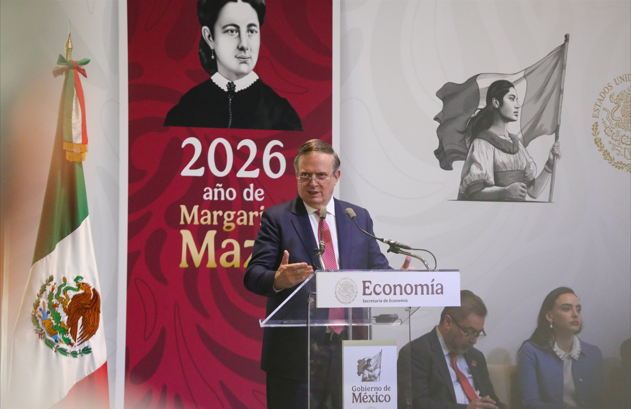
Marcelo Ebrard, Secretary of Economy, led the event at which the conclusions of these consultations were presented at the headquarters of the Ministry of Economy in Mexico City.
Logistical disruptions
As part of the conclusions of these consultations, the Ministry of Economy noted that regional productive integration has not only generated efficiency and growth, but has also become a mechanism for reducing vulnerabilities to logistical disruptions, external shocks, and geopolitical risks.
Participants in the consultation identified as a central challenge for the coming years the need to increase the national and regional content of what is produced and traded within the bloc, not with the aim of reversing openness, but to deepen integration and expand the generation of value and employment in the region.
The region’s structural logistical advantage is an additional pillar of this dynamic. The geographical proximity between Mexico, the United States, and Canada allows for delivery times of one to three days, compared to weeks from Asia or Europe, enabling just-in-time production schemes that are difficult to replicate with other trading partners.
Border crossings
In 2024, border crossings reached an approximate value of $2.562 billion per day in goods and services, equivalent to $1.8 million per minute, illustrating the economic density of this relationship.
Discussions in the United States reinforce this reading by emphasizing that the possibility of inputs and components crossing the border multiple times is one of the region’s main competitive strengths and that it is weakened by the imposition of tariffs on these inputs.
The impact of the USMCA on employment and economic activity is equally relevant. Mexico is the destination for around $334 billion in U.S. exports, representing about 16.2% of the country’s total exports.
More than 50,000 US small and medium-sized enterprises export to Mexico for a value of close to $107 billion, and the country has become the main export market for states with a strong manufacturing base, such as Michigan, Texas, Kentucky, and Alabama.
Overall, it is estimated that around 56.2 million jobs in the three countries are linked to trade in goods within the USMCA region, and more than 10 million depend directly on exports.