

In 2025, China recorded a significant decline among the main countries with which the US has its largest trade deficits.
This negative balance was reduced at an annual rate of 31.6% to $202.071 billion, according to data from the Department of Commerce. This amount is the result of exports totaling $106.308 billion and imports totaling $308.380 billion.
Increase in the US trade deficit
In its 2026 trade policy agenda and 2025 annual report, the USTR stated that last year’s data proves that the “America First” trade policy is working.
Since President Donald Trump began implementing his policy in April 2025, the goods trade deficit has declined year-over-year every month through December 2025.
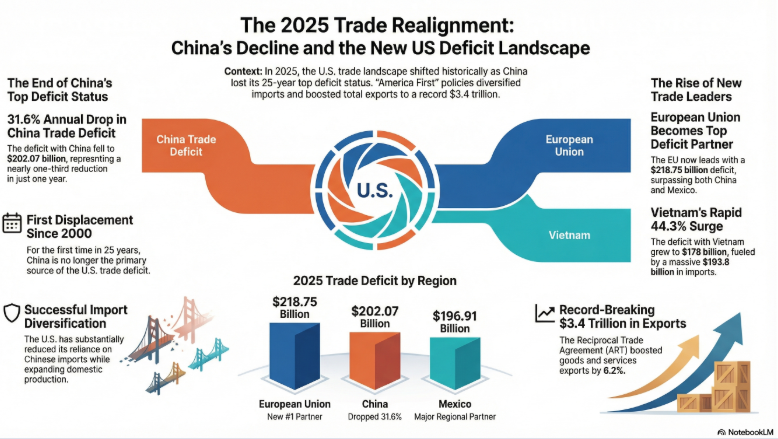
Furthermore, the main driver of the overall U.S. goods trade deficit, the trade deficit with China, declined by nearly one-third in 2025. For the first time since 2000, China is no longer the trading partner with which the United States has the largest trade deficit.
In other words, in just one year, the United States significantly diversified its import sources and reduced its dependence on Chinese imports.
In 2025, the United States recorded its largest trade deficit with the European Union, amounting to $218.750 billion. This was the result of exports totaling $414.428 billion and imports totaling $633.179 billion.
Reciprocal Trade Agreement
In addition to the change in the profile of U.S. imports, the USTR emphasized that trade policy promotes an increase in U.S. exports and the expansion of domestic production.
Since the launch of the Reciprocal Trade Agreement (RTA) program to expand market access for U.S. workers and businesses, exports of goods and services have increased by $199.8 billion (6.2%), reaching a record high of $3.4 trillion.
With Mexico, the U.S. trade deficit stood at $196.913 billion, with the United States recording $337.960 billion in exports and $534.874 billion in imports.
Finally, among all US trade deficits, the one with Vietnam stood out in particular, at $178.183 billion, an increase of 44.3% year-on-year, with exports of $15.657 billion and imports of $193.840 billion.
The US trade deficit can be explained by strong domestic consumption, the appreciation of the dollar, the relocation of production to Asia, particularly China, the decline in domestic savings relative to investment, and global supply chains that favor imports of competitive intermediate and final goods.
In 2025, the United States recorded a trade deficit of $1.23 trillion, 2.1% higher than in 2024.