

Chinese car exports reached $110.422 billion in 2025, a year-on-year growth of 22%, consolidating China’s position among the world’s largest exporters. Russia, the United Arab Emirates, the United Kingdom, Belgium, and Mexico accounted for the main flows, according to China’s General Administration of Customs.
This performance confirms the structural acceleration of Chinese automotive foreign trade. After growing 83% in 2022, 74% in 2023, and 16% in 2024, the sector maintains an expansive trajectory supported by electric mobility, industrial integration, and market diversification under a less restrictive trade policy environment.
Main export destinations and year-on-year dynamics
Russia led the destinations in 2025 with $8.463 billion, although it recorded an annual contraction of 44%. In contrast, the United Arab Emirates captured $8.073 billion, with an increase of 70%, reflecting the reconfiguration of supply chains and trade triangulation.
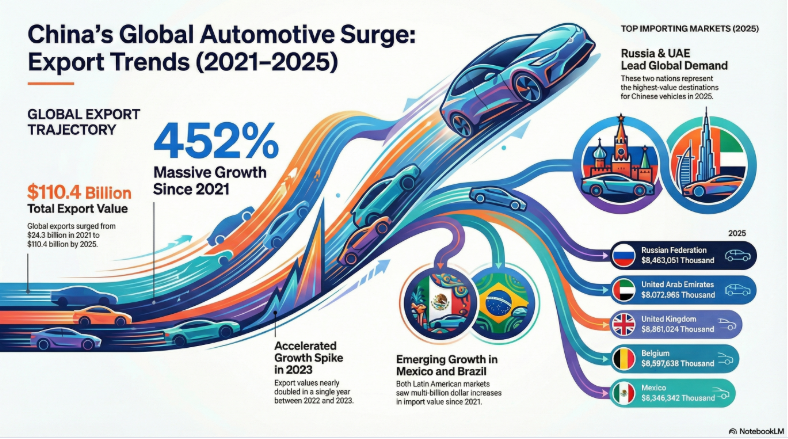
The United Kingdom imported $6.861 billion in Chinese cars, an increase of 47%. Belgium reached $6.598 billion, with a drop of 9%. Mexico ranked fifth with $6.346 billion, growing 45%, a relevant indicator for automotive foreign trade in North America.
Competitive advantages over other exporting nations
The growth in Chinese car exports is underpinned by leadership in electric mobility, competitive prices, government support, and an integrated supply chain. Mass manufacturing, advanced battery technology, and expansion into emerging markets strengthen their position against competitors from Europe, Japan, and the United States.
Key companies include BYD for vertical integration in batteries; SAIC Motor for scale and global alliances; Geely for strategic acquisitions; Changan Automobile for state R&D; and Great Wall Motor for specialization in electric SUVs.
Macroeconomic context and business environment
In the fourth quarter of 2025, the Chinese economy grew by 1.2% in real terms, up from 1.1% previously. Annual growth stood at 5.0%, in line with the official target. Industrial production remained buoyant, driven by green manufacturing and artificial intelligence components.
Net exports continued to contribute to growth, favored by resilient external demand, a competitive exchange rate, and cooling tariff tensions. However, domestic demand showed weakness, with a slowdown in retail sales and a contraction in fixed investment, particularly in the residential sector.
Consumer inflation closed at 0.8% annually, its highest level since 2023, although contained. This macroeconomic environment reinforces the relative dependence on foreign trade and raises strategic questions about export sustainability, regulatory risks, and nearshoring opportunities in markets such as Mexico.