

The United States reduced its imports of Chinese computers by 70% in 2025, to $10.839 billion.
The adjustment reshapes foreign trade in the technology sector. Mexico positioned itself as the main supplier in an environment marked by nearshoring, the strengthening of Asian hubs, differentiated tariffs, and the redefinition of supply chains.
Imports of Chinese computers
China had reached an all-time high in 2021, with computer exports to the United States totaling $61.33 billion. However, it accumulated four consecutive years of year-on-year declines. In 2025, it fell to fifth place as a supplier to the U.S. market, reflecting structural changes in trade policy and corporate strategy.
In contrast, Mexico led with $89.913 billion, followed by Taiwan ($85.498 billion), Vietnam ($33.76 billion), and Thailand ($20.814 billion), according to statistics from the Department of Commerce. The classification includes automatic data processing machines, magnetic readers, and peripheral units, among other goods.
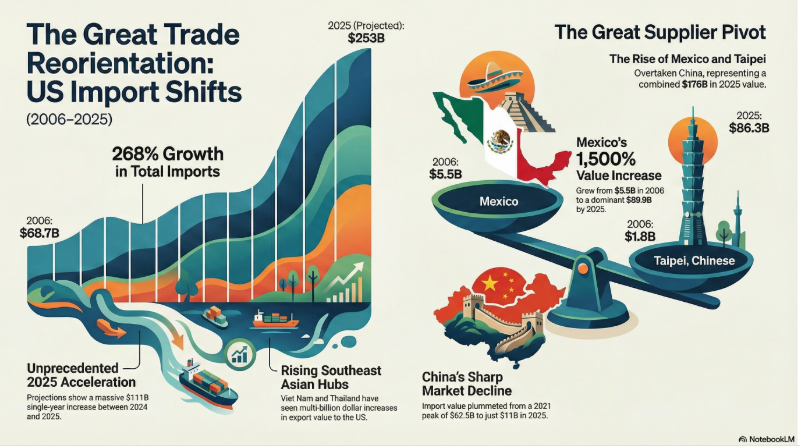
Total U.S. imports of these goods totaled $251.026 billion in 2025, a year-on-year increase of 79%. The growth was driven by the expansion of data centers, artificial intelligence, and the renewal of corporate digital infrastructure.
Artificial intelligence and data centers drive demand
The boom in artificial intelligence projects generated heavy investment in high-performance servers and systems. Technology companies expanded their training and inference capacity. This investment cycle strengthened external demand, increasing trade flows under regional integration and productive diversification schemes.
Likewise, anticipation of possible additional tariffs and export controls encouraged advance purchases. U.S. trade policy, combined with geopolitical tensions, accelerated sourcing decisions and favored the partial relocation of manufacturing processes to North America.
Mexico capitalizes on nearshoring and the USMCA
According to the Bank of Mexico, nearshoring catalyzed the relocation of assembly lines from Asia to Mexican territory. The United States-Mexico-Canada Agreement (USMCA) provided legal certainty, clear rules of origin, and tariff advantages over Asian competitors.
Mexico consolidated its integration into regional supply chains, with greater North American content. Logistical proximity, shorter delivery times, and installed capacity strengthened its export profile. This performance is also linked to increased foreign direct investment flows in electronic manufacturing.
In December 2025, the United States imposed a 0.2% tariff on computers originating in Mexico, compared to 12.1% for Chinese products. The tariff gap deepens the redistribution of foreign trade and redefines business incentives.
Strategic implications for companies and authorities
China’s displacement raises executive questions: How will tariffs evolve? Will nearshoring consolidate as a structural strategy? What risks remain in supply chains dependent on Asian components?
Organizations such as the World Trade Organization document that geo-economic fragmentation tends to raise costs, but also to generate regional hubs of advanced manufacturing.