

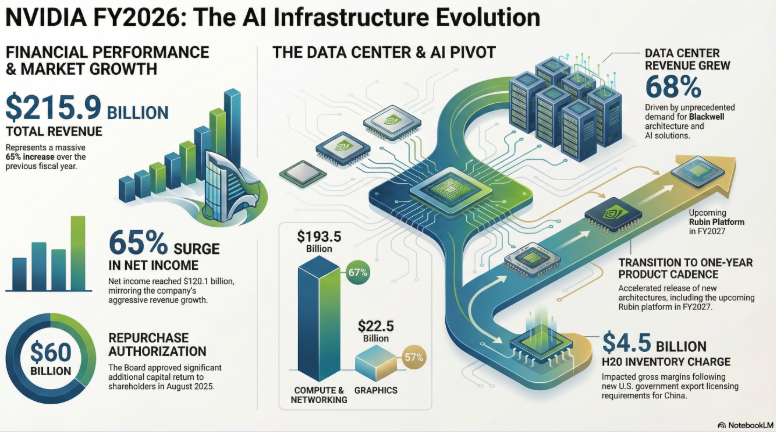
The boom in NVIDIA data centers lifted its revenue by 68.2% year-on-year to $193.737 billion in fiscal year 2025, which ended on January 26, 2026. This growth consolidates the company as a key player in global artificial intelligence infrastructure and redefines the dynamics of foreign trade in technology.
Revenue by end market in data centers rose from $47.525 billion in 2023 to $115.186 billion in 2024. In 2025, the jump was driven by the massive adoption of accelerated computing and architectures optimized for generative AI. The Compute & Networking segment integrates these results.
NVIDIA data centers
The segment’s operating income rose to $130.141 billion in 2025, up from $82.875 billion in 2024. The margin reflects economies of scale and a revenue mix concentrated on high value-added solutions.
In parallel, the company’s total revenue reached $215.938 billion in 2025, with annual growth of 65.5%. Net income totaled $120.067 billion, an increase of 64.7%. The expansion confirms the centrality of the data center as the new economic unit of computing.
What explains the growth in data centers?
The NVIDIA Data Center platform integrates GPUs, CPUs, and high-performance interconnects, along with CUDA software and CUDA-X libraries. This architecture reduces the total cost of ownership compared to CPU-only models and optimizes AI, HPC, and big data analytics workloads.
Its deployment spans public clouds, hyperscale data centers, and edge environments. In addition, the infrastructure is marketed in rack-scale modular systems, integrating hardware, software, and specialized services.
Technological competition and regulatory risks
Competition comes from Advanced Micro Devices (AMD) and Intel in GPUs and CPUs, as well as from internal developments by Amazon and Microsoft. The strategic differential is defined by energy performance, scalability, and systemic efficiency.
From a trade policy perspective, foreign trade in advanced semiconductors faces potential restrictions, export controls, and tariff adjustments. Technology regulation, within the framework of the World Trade Organization (WTO), affects the configuration of global supply chains.
Implications for nearshoring and foreign direct investment
The rapid growth of data centers at NVIDIA increases demand for advanced manufacturing, electronic components, and specialized logistics. This opens up opportunities related to nearshoring and foreign direct investment in economies with robust trade agreements.
Countries integrated into North America under schemes such as the USMCA could capture strategic links in assembly, testing, or systems integration. However, factors such as energy infrastructure, legal certainty, and industrial policy will be decisive.
Strategic impact on technological foreign trade
The rise of data centers at NVIDIA confirms the transition to a digital economy intensive in AI infrastructure. For executives and foreign trade managers, the central question is how to capture value in the new technological geography.
The answer involves public-private coordination, incentives for innovation, and alignment with existing trade agreements. It also requires anticipating geopolitical and regulatory risks that could alter international trade flows.